http://www.gannglobal.com/webinar/2016/August/321gold/16-08-Video1.php
Can you say 20008?
Wednesday, August 31, 2016
JDST ( possible tripple top in play? )
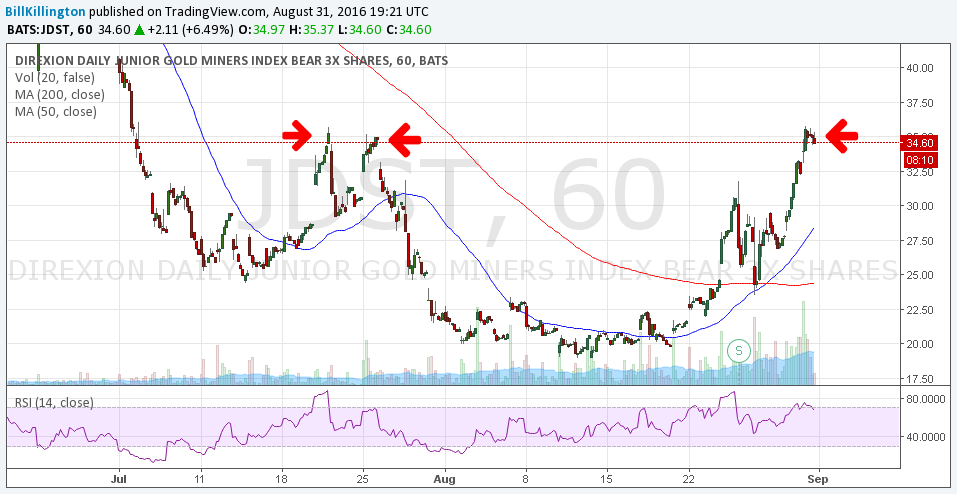
Went long NUGT at these prices its a no brainier, way to much bearishness and the DXY is not confirming this move.
Note I am still holding JDST one more day or maybe as long as Friday after NFP just to be safe let's see if they a pull a final blood bath phase to hit the lower stops.
This is just the bankers buying cheap shares for the next cycle leg..again ...the DXY is not confirming this bearishness fact is it stalled today and failed the 50ma once again ... Telling
Bill Gross on CNBC
- Yes, the Fed will raise rates in September
- Pension funds must lower expectations on payments
- Removing Rousseff doesn't improve Brazilian bonds
- The Fed believes low rates are a positive; I think they're negative
- We need classic fiscal stimulus
- The central bank basically says to the fiscal authority that you don't need to pay
- "Let's raise rates in Sept and again in 6-9 months"
- There are 11 trillion in negative rate bonds; those are liabilities, not assets
Abercrombie & Fitch closing up to 60 stores nationally
http://www.wrcbtv.com/story/32899948/abercrombie-fitch-closing-up-to-60-stores-nationally
Abercrombie & Fitch Co. reported a wider loss for its second quarter on Tuesday and said it's closing up to 60 stores in the United States as both U.S. and international sales fell.
The teen-focused retailer also offered a downbeat outlook for a key sales measure, as business continues to be hurt by a decline in tourists to its flagships in key cities. The closures will represent about 8 percent of its store count in the domestic market. Abercrombie's shares tumbled more than 20 percent in midday trading.
Abercrombie, once a top destination for teens, has struggled to adjust as its customers increasingly shop on their phones and other mobile devices, and shift more to fast-fashion chains like H&M. The retailer is changing its marketing to play down its sexy image, and last year got rid of provocative pictures on its shopping bags and bare-chested male models greeting customers at the door. It also gave employees more freedom to dress how they wish, ditching its "look policy" that banned eyeliner and certain hairstyles among other rules.
Abercrombie & Fitch Co. reported a wider loss for its second quarter on Tuesday and said it's closing up to 60 stores in the United States as both U.S. and international sales fell.
The teen-focused retailer also offered a downbeat outlook for a key sales measure, as business continues to be hurt by a decline in tourists to its flagships in key cities. The closures will represent about 8 percent of its store count in the domestic market. Abercrombie's shares tumbled more than 20 percent in midday trading.
Abercrombie, once a top destination for teens, has struggled to adjust as its customers increasingly shop on their phones and other mobile devices, and shift more to fast-fashion chains like H&M. The retailer is changing its marketing to play down its sexy image, and last year got rid of provocative pictures on its shopping bags and bare-chested male models greeting customers at the door. It also gave employees more freedom to dress how they wish, ditching its "look policy" that banned eyeliner and certain hairstyles among other rules.
China's Biggest-Ever Metals Deal Snaps Up Cleveland's Aleris
http://www.bloomberg.com/news/articles/2016-08-30/china-s-biggest-ever-metals-deal-snaps-up-cleveland-s-aleris
China's influence in global metals markets just stepped up a gear after the owner of its top supplier of aluminum products agreed to buy Aleris Corp. of the U.S. for $2.3 billion, marking the nation's biggest-ever overseas purchase of a metals processor.
...
China Zhongwang is Asia's biggest producer of extruded aluminum, and already has ambitions to sell aluminum sheet to China's emerging auto and aerospace industries. It's due this year to start up a flat-rolled aluminum plant in Tianjin, near Beijing, which will supply products that China still has to import.
China's influence in global metals markets just stepped up a gear after the owner of its top supplier of aluminum products agreed to buy Aleris Corp. of the U.S. for $2.3 billion, marking the nation's biggest-ever overseas purchase of a metals processor.
...
China Zhongwang is Asia's biggest producer of extruded aluminum, and already has ambitions to sell aluminum sheet to China's emerging auto and aerospace industries. It's due this year to start up a flat-rolled aluminum plant in Tianjin, near Beijing, which will supply products that China still has to import.
Meet TISA, the 'secret privatisation pact that poses a threat to democracy'
http://www.independent.co.uk/news/business/news/ttip-trade-deal-new-what-is-tisa-privatisation-pact-secret-threat-to-democracy-a7216296.html
Few people may have heard of the Trade In Services Agreement, but campaign group Global Justice Now warns in a new report: "Defeating TTIP may amount to a pyrrhic victory if we allow TISA to pass without challenge."
Like the Transatlantic Trade and Investment Partnership, TISA is being negotiated in secret, even though it could have a major impact on countries which sign up.
...
"TISA threatens public services. From postal services to the NHS, TISA could lock in privatisation and ensure that big multinationals increasingly call the shots on areas like health, education and basic utilities."
A so-called "ratchet" clause in the deal means that after a service -- like trains or water or energy -- is privatised, this is almost impossible to reverse even if it fails.
Few people may have heard of the Trade In Services Agreement, but campaign group Global Justice Now warns in a new report: "Defeating TTIP may amount to a pyrrhic victory if we allow TISA to pass without challenge."
Like the Transatlantic Trade and Investment Partnership, TISA is being negotiated in secret, even though it could have a major impact on countries which sign up.
...
"TISA threatens public services. From postal services to the NHS, TISA could lock in privatisation and ensure that big multinationals increasingly call the shots on areas like health, education and basic utilities."
A so-called "ratchet" clause in the deal means that after a service -- like trains or water or energy -- is privatised, this is almost impossible to reverse even if it fails.
U.S. Treasuries are Heading for Their Biggest Monthly Loss Since June 2015

Treasury securities traders are beginning to fear a Federal Reserve rate hike later this year.
There is no chance the Fed is going to reverse the December 2015 rate hike anytime soon. Holding the view that a near-term plunge to negative rates in the U.S. is likely is the height of confusion about the current state of the economy and how the Federal Reserve operates.
Nigeria Price Inflation Accelerates to Highest in Nearly 11 Years

When you can't sell oil that you pump for top dollar, I guess the solution is to just print money.
Nigerian inflation accelerated for the ninth consecutive month in July.
The inflation rate increased to 17.1 percent from 16.5 percent in June, the Abuja-based National Bureau of Statistics said in a statement issued today.
Global central bankers, stuck at zero, unite in plea for help from governments
https://ca.news.yahoo.com/global-central-bankers-stuck-zero-unite-plea-help-123135496--business.html
Central bankers in charge of the vast bulk of the world's economy delved deep into the weeds of money markets and interest rates over a three-day conference here, and emerged with a common plea to their colleagues in the rest of government: please help.

Central bankers in charge of the vast bulk of the world's economy delved deep into the weeds of money markets and interest rates over a three-day conference here, and emerged with a common plea to their colleagues in the rest of government: please help.
Mired
in a world of low growth, low inflation and low interest rates,
officials from the Federal Reserve, Bank of Japan and the European
Central Bank said their efforts to bolster the economy through monetary
policy may falter unless elected leaders stepped forward with bold
measures. These would range from immigration reform in Japan to
structural changes to boost productivity and growth in the U.S. and
Europe.
US EIA weekly oil inventories +2276K vs +1300K expected
- Prior was +2501K
- Gasoline -691K vs -1000K exp
- Distillates +1496K vs -125K exp
- Cusing inventory -1039K vs +400K
- Production -0.7% w/w and -7.9% y/y
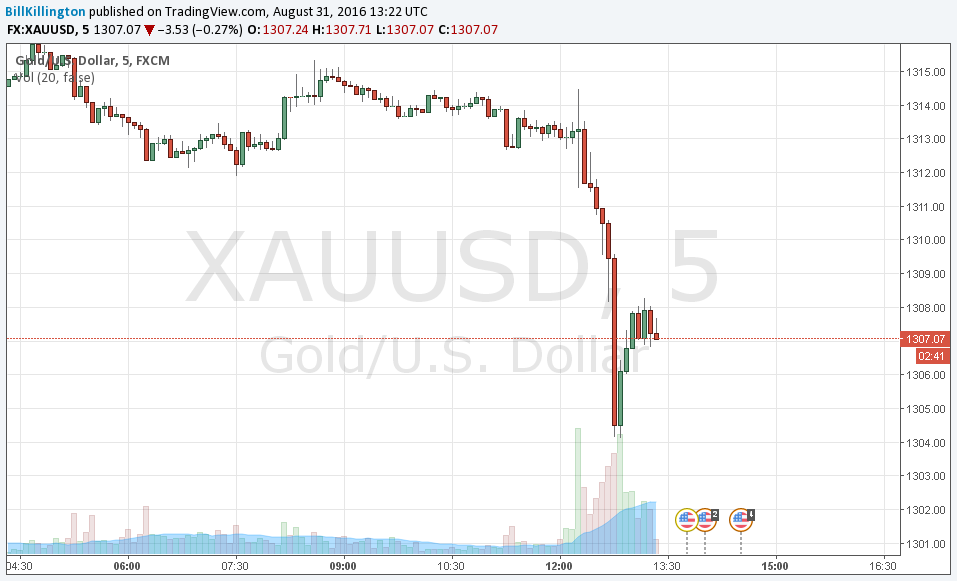
Expect Big Gold and Silver RAID Tomorrow! – Harvey Organ
http://www.silverdoctors.com/silver/silver-news/expect-big-gold-and-silver-raid-tomorrow-harvey-organ/
He nailed it...
EXPECT A GOOD SIZED RAID ON GOLD AND SILVER AHEAD OF TOMORROW’S OTC/LBMA EXPIRY…
BOTH RUSSIA AND THE USA ANGRY AT TURKEY’S INVASION OF SYRIA/AFTER TODAY’S GRAB BY THE EU ON APPLE, THEY SET THEIR SIGHTS ON AMAZON AND MCDONALD’S/ THE FBI UNCOVER EMAILS FROM HILLARY’ SERVER ON BENGHAZI AND THUS SHE LIED UNDER OATH/GOOD SIZED RAID ON GOLD AND SILVER AHEAD OF TOMORROW’S OTC/LBMA EXPIRY
He nailed it...
EXPECT A GOOD SIZED RAID ON GOLD AND SILVER AHEAD OF TOMORROW’S OTC/LBMA EXPIRY…
BOTH RUSSIA AND THE USA ANGRY AT TURKEY’S INVASION OF SYRIA/AFTER TODAY’S GRAB BY THE EU ON APPLE, THEY SET THEIR SIGHTS ON AMAZON AND MCDONALD’S/ THE FBI UNCOVER EMAILS FROM HILLARY’ SERVER ON BENGHAZI AND THUS SHE LIED UNDER OATH/GOOD SIZED RAID ON GOLD AND SILVER AHEAD OF TOMORROW’S OTC/LBMA EXPIRY
Friday’s Jobs Report Could Trigger A Stock Market CRASH – Stewart Thomson
http://www.silverdoctors.com/gold/gold-news/fridays-jobs-report-could-trigger-a-stock-market-crash-stewart-thomson/
- At the current pace of quantitative easing, Japan’s central bank is buying so many bonds that it now has about 24 months left before there are no more bonds left to buy.
- The BOJ is buying close to $800 billion (USD) of bonds annually. The bank’s QE program is truly gargantuan, and Kuroda made a key speech at Jackson Hole indicating he has no intention of tapering it at all.
- Please click here now. Gold is extremely well-supported now, by both equity fund and FOREX money managers.
- Kuroda hinted at Jackson Hole that while he won’t taper QE, he has substantial room to increase the use of his negative rates program. He’s making another key speech next Monday, and I expect him to make it clear that as enormous as his QE program is, he’s going to lower interest rates further, and make it even more important policy than QE.
- The US jobs report is scheduled for release this Friday at 8:30AM. When Janet Yellen hiked rates last December, a huge institutional panic out of stock markets and the dollar developed.
- These institutions surged into gold and the yen. A big jobs report number is likely to spur Janet to unveil a second rate hike at the September 21 FOMC meeting.
- This is probably the most important jobs report of the entire year, and Janet’s reaction to it could begin a major stock market and US dollar crash.
- The September and October time-frame is what I call “US stock market crash season”. The worst stock market crashes have historically occurred during these months, and Friday’s jobs report has the potential to create another one.
- Gold price enthusiasts should pay keen attention to all the upcoming speeches made by key players at both the BOJ and the Fed. Those speeches and policy decisions are likely to create important changes on the charts that gold market technicians focus on.
Chicago PMI 51.5 vs 54.0 expected
- Prior was 55.8
- Inventories 49.8 vs 52.0 prior
- Employment highest since April 2015
- New orders and production at lowest since May
- Prices paid lowest since March

US July pending home sales +1.3% vs +0.7% m/m expected
- Prior was +0.2% m/m (revised to -0.8%)
- Sales -2.2% y/y vs +2.2% exp
- Prior y/y reading was +0.3% (revised to -0.7%)
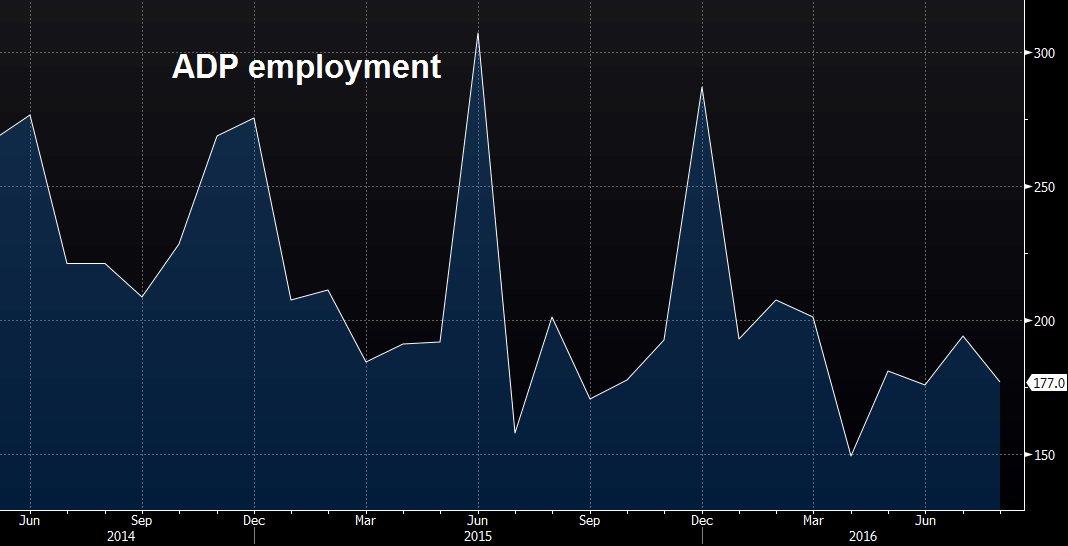
ADP August employment +177K vs +175K expected
- Prior was 179K (revised to 194K)
- Economist estimates ranged from 225K to 135K
On its own, I don't know if the Fed will take anything away from this. Over the past five months, the average ADP employment gain is 175K, which is the lowest since July 2013.
SWIFT discloses more cyber thefts, pressures banks on security
http://uk.reuters.com/article/us-cyber-heist-swift-idUKKCN11600C
SWIFT, the global financial messaging system, on Tuesday disclosed new hacking attacks on its member banks as it pressured them to comply with security procedures instituted after February's high-profile $81 million heist at Bangladesh Bank.
In a private letter to clients, SWIFT said that new cyber-theft attempts - some of them successful - have surfaced since June, when it last updated customers on a string of attacks discovered after the attack on the Bangladesh central bank.
"Customers’ environments have been compromised, and subsequent attempts (were) made to send fraudulent payment instructions," according to a copy of the letter reviewed by Reuters. "The threat is persistent, adaptive and sophisticated - and it is here to stay."
So they're basically admitting we want to monitor all transactions
SWIFT, the global financial messaging system, on Tuesday disclosed new hacking attacks on its member banks as it pressured them to comply with security procedures instituted after February's high-profile $81 million heist at Bangladesh Bank.
In a private letter to clients, SWIFT said that new cyber-theft attempts - some of them successful - have surfaced since June, when it last updated customers on a string of attacks discovered after the attack on the Bangladesh central bank.
"Customers’ environments have been compromised, and subsequent attempts (were) made to send fraudulent payment instructions," according to a copy of the letter reviewed by Reuters. "The threat is persistent, adaptive and sophisticated - and it is here to stay."
So they're basically admitting we want to monitor all transactions
US MBA mortgage applications w-e 26 Aug 2.8% vs -21.% prev
- 30-year mortgage rate 3.67% as prev
- mortgage refinance index 2441.7 vs 2355.2 prev
- purchase index 216.1 vs 213.4 prev
- mortgage market index 545.2 vs 530.1 prev
Not a price mover in its own right but all to throw into the mix

Milton Friedman and Phil Donahue On Socialism v. Capitalism
Very few people in history are as dank as Milton Friedman. Trump’s
policies are heavily informed by him – even trade, if you study the
complexities of the issue. Trump always says he isn’t against free trade
– only stupid 50,000 page trade deals. Those deals don’t sound so free
to me.
policies are heavily informed by him – even trade, if you study the
complexities of the issue. Trump always says he isn’t against free trade
– only stupid 50,000 page trade deals. Those deals don’t sound so free
to me.
Wednesday
MBA Mortgage Applications
![[Report]](http://b-us.econoday.com/images/b-global/byreport_butt_new.gif)
 7:00 AM ET
7:00 AM ETNeel Kashkari Speaks8:00 AM ET
ADP Employment Report
![[Report]](http://b-us.econoday.com/images/b-global/byconsensus_butt.gif)
![[djStar]](http://b-us.econoday.com/images/b-global/djstar.gif) 8:15 AM ET
8:15 AM ET
8:15 AM ET
Chicago PMI
9:45 AM ET
9:45 AM ET
Pending Home Sales Index
10:00 AM ET
10:00 AM ET
EIA Petroleum Status Report
![[Star]](http://b-us.econoday.com/images/b-global/star.gif) 10:30 AM ET
10:30 AM ET
10:30 AM ET
Farm Prices
3:00 PM ET
3:00 PM ETCharles Evans Speaks3:15 PM ET
A Candidate’s Death Could Delay or Eliminate the Presidential Election
http://www.usnews.com/news/articles/2016-08-30/candidate-death-could-delay-or-eliminate-presidential-election
Chaos would ensue if a vacancy emerges near Election Day.
The presidential election could be delayed or scrapped altogether if conspiracy theories become predictive and a candidate dies or drops out before Nov. 8. The perhaps equally startling alternative, if there’s enough time: Small groups of people hand-picking a replacement pursuant to obscure party rules.
The scenarios have been seriously considered by few outside of the legal community and likely are too morbid for polite discussion in politically mixed company. But prominent law professors have pondered the effects and possible ways to address a late-date vacancy.
“There’s nothing in the Constitution which requires a popular election for the electors serving in the Electoral College,” says John Nagle, a law professor at the University of Notre Dame, meaning the body that officially elects presidents could convene without the general public voting.
“It’s up to each state legislature to decide how they want to choose the state’s electors,” Nagle says. “It may be a situation in which the fact that we have an Electoral College, rather than direct voting for presidential candidates, may prove to be helpful.”
Chaos would ensue if a vacancy emerges near Election Day.
The presidential election could be delayed or scrapped altogether if conspiracy theories become predictive and a candidate dies or drops out before Nov. 8. The perhaps equally startling alternative, if there’s enough time: Small groups of people hand-picking a replacement pursuant to obscure party rules.
The scenarios have been seriously considered by few outside of the legal community and likely are too morbid for polite discussion in politically mixed company. But prominent law professors have pondered the effects and possible ways to address a late-date vacancy.
“There’s nothing in the Constitution which requires a popular election for the electors serving in the Electoral College,” says John Nagle, a law professor at the University of Notre Dame, meaning the body that officially elects presidents could convene without the general public voting.
“It’s up to each state legislature to decide how they want to choose the state’s electors,” Nagle says. “It may be a situation in which the fact that we have an Electoral College, rather than direct voting for presidential candidates, may prove to be helpful.”
Fed's Fischer: Negative Rates Just Dandy
http://www.bloomberg.com/news/articles/2016-08-30/fed-s-fischer-says-negative-rates-seem-to-work-in-today-s-world
Federal Reserve Vice Chairman Stanley Fischer said negative interest rates seem to be working in other countries, while reinforcing that they aren't on the table in the U.S.
While the Fed isn't "planning to do anything in that direction," the central banks using them "basically think they're quite successful," Fischer said Tuesday on Bloomberg Television with Tom Keene in Washington. He reiterated that Fed rate increases will be data dependent without giving a specific timeline.
As we recall, Japan's Kuroda was swearing that negative rates were "off the table" until the day before they were announced...
Federal Reserve Vice Chairman Stanley Fischer said negative interest rates seem to be working in other countries, while reinforcing that they aren't on the table in the U.S.
While the Fed isn't "planning to do anything in that direction," the central banks using them "basically think they're quite successful," Fischer said Tuesday on Bloomberg Television with Tom Keene in Washington. He reiterated that Fed rate increases will be data dependent without giving a specific timeline.
As we recall, Japan's Kuroda was swearing that negative rates were "off the table" until the day before they were announced...
The 11 Bone-Chilling Things I Gleaned from Yellen's Chart
http://wolfstreet.com/2016/08/27/yellens-fan-chart-federal-funds-rate-projections/
hey have no clue, but they know how to talk. The chart confirms the Fed's message: They say whatever they want to in order to inflate financial markets and drive even conservative investors into huge risks without much compensation, and that's pretty much all they'll ever do.''
hey have no clue, but they know how to talk. The chart confirms the Fed's message: They say whatever they want to in order to inflate financial markets and drive even conservative investors into huge risks without much compensation, and that's pretty much all they'll ever do.''
Tuesday, August 30, 2016
If You Accept this Raise, You Fall Off the Welfare Cliff
https://fee.org/articles/if-you-accept-this-raise-you-fall-off-the-welfare-cliff/
At your present $12 an hour you are eligible for refundable tax credits, food assistance, housing assistance, child care assistance, and medical assistance worth $41,465 combined. Together with your earned income after taxes of $22,121, you are now bringing home to your kids about $63,586 a year.
If you take your employer’s offer, you’ll earn $5,451 more after taxes, $27,572. You will also become eligible for an Affordable Care Act (ACA) premium tax credit. But at that level of earned income all your other benefits would decrease by $8,336, more than your increase in net pay. That means the income you would bring home would decrease from $63,586 to $60,701.
Now you see the inner workings on how the Government traps people into the system ...
Eliminate government welfare replacing it with private charity - AS IT WAS FOR MOST OF THIS COUNTRY'S EXISTENCE.
JDST
We said to hedge I hope you did
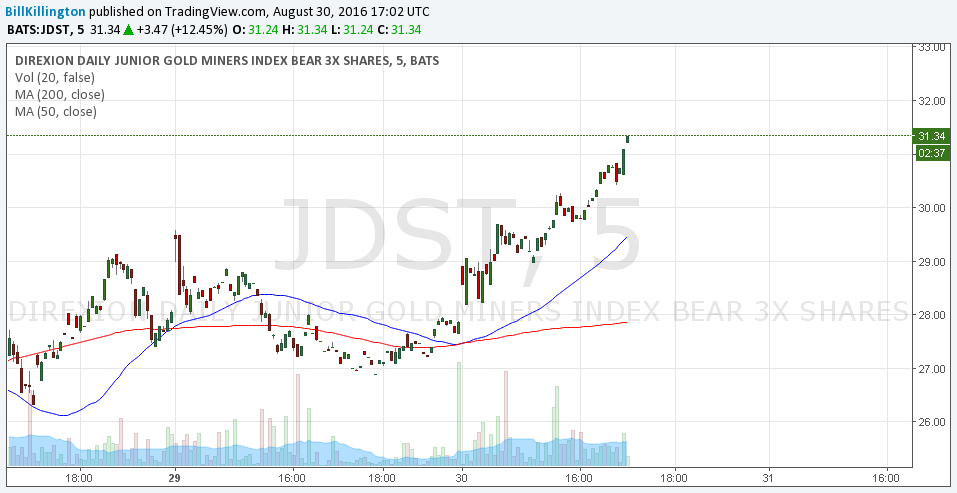
Gold @ 1312 will be an interesting moment, let see what happens.
Gold @ 1312 will be an interesting moment, let see what happens.
Europe hits Apple w $14.6B Tax Bill
http://money.cnn.com/2016/08/30/technology/apple-tax-eu-us-ireland/index.html
The tax ruling is the biggest the European Union has ever made regarding a single company, and it could spark a huge transatlantic row over how Europe treats U.S. companies.
Apple shares initially fell almost 3%, but then recovered most of their
losses. The company will appeal the decision. It said the ruling
upended the international tax system and would damage jobs and
investment in Europe.
The European Commission, which administers EU law, said the Irish government had granted illegal state aid to Apple (AAPL, Tech30) by helping the tech giant to artificially lower its tax bill for more than 20 years.

The tax ruling is the biggest the European Union has ever made regarding a single company, and it could spark a huge transatlantic row over how Europe treats U.S. companies.
The European Commission, which administers EU law, said the Irish government had granted illegal state aid to Apple (AAPL, Tech30) by helping the tech giant to artificially lower its tax bill for more than 20 years.
US Aug consumer confidence 101.1 vs 97.0 expected
- Prior was 97.3
- Highest since Sept 2015
- Present situation 123.0 vs 96.7 prior
- Expectations 86.4 vs 82.0 prior
- Jobs hard to get 23.4 vs 22.1 prior
- 1-year inflation expectations 4.8% vs 4.7% prior
The Cancer Industry is Too Prosperous to Allow a Cure
http://healthimpactnews.com/2014/the-cancer-industry-is-too-prosperous-to-allow-a-cure/
We have lost the war on cancer. At the beginning of the last century, one person in twenty would get cancer. In the 1940s it was one out of every sixteen people. In the 1970s it was one person out of ten. Today one person out of three gets cancer in the course of their life.
The cancer industry is probably the most prosperous business in the United States. In 2014, there will be an estimated 1,665,540 new cancer cases diagnosed and 585,720 cancer deaths in the US. $6 billion of tax-payer funds are cycled through various federal agencies for cancer research, such as the National Cancer Institute (NCI). The NCI states that the medical costs of cancer care are $125 billion, with a projected 39 percent increase to $173 billion by 2020.
The simple fact is that the cancer industry employs too many people and produces too much income to allow a cure to be found. All of the current research on cancer drugs is based on the premise that the cancer market will grow, not shrink.
John Thomas explains to us why the current cancer industry prospers while treating cancer, but cannot afford to cure it.
We have lost the war on cancer. At the beginning of the last century, one person in twenty would get cancer. In the 1940s it was one out of every sixteen people. In the 1970s it was one person out of ten. Today one person out of three gets cancer in the course of their life.
The cancer industry is probably the most prosperous business in the United States. In 2014, there will be an estimated 1,665,540 new cancer cases diagnosed and 585,720 cancer deaths in the US. $6 billion of tax-payer funds are cycled through various federal agencies for cancer research, such as the National Cancer Institute (NCI). The NCI states that the medical costs of cancer care are $125 billion, with a projected 39 percent increase to $173 billion by 2020.
The simple fact is that the cancer industry employs too many people and produces too much income to allow a cure to be found. All of the current research on cancer drugs is based on the premise that the cancer market will grow, not shrink.
John Thomas explains to us why the current cancer industry prospers while treating cancer, but cannot afford to cure it.
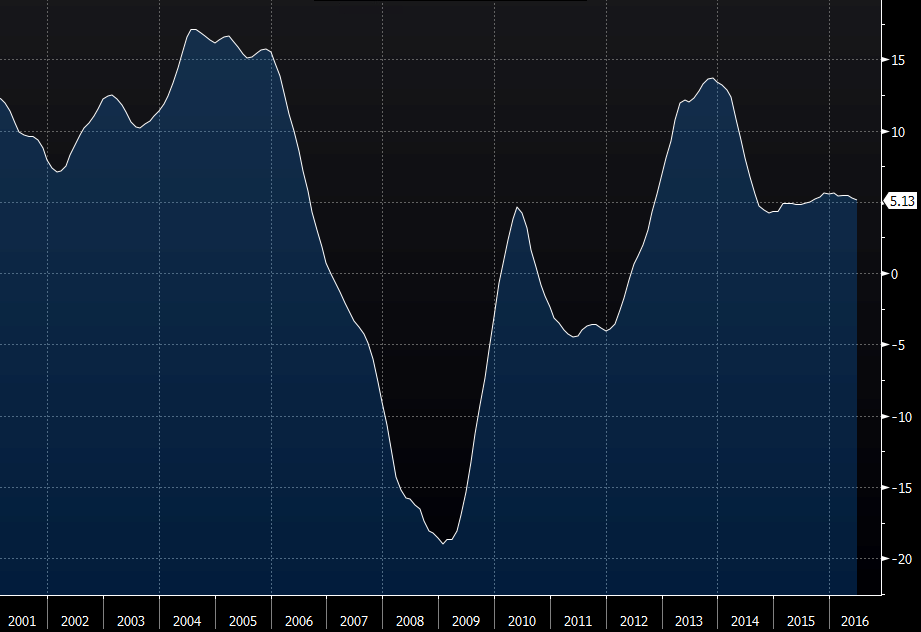
Case-Shiller June 20-city US house price index -0.07% m/m vs -0.10% exp
- Prices up 5.13% y/y vs +5.12% exp
- May prices were up 5.25% y/y
- Overall house price index +0.21% m/m vs +0.13% prior
Here's a look at the Case-Shiller house price index:
Iran has reached pre-sanctions oil output - Minister
Iran has long said it wouldn't consider a production freeze until it had regained its pre-sanctions output level.
At a conference in Norway, Deputy minister for industry, mining and trade Moazami said the country is currently producing 3.8 million barrels per day. That's up from 3.6mbpd in the latest OPEC data.
Iran's production hasn't been above 4mbpd since the 1970s.

At a conference in Norway, Deputy minister for industry, mining and trade Moazami said the country is currently producing 3.8 million barrels per day. That's up from 3.6mbpd in the latest OPEC data.
Iran's production hasn't been above 4mbpd since the 1970s.
Clinton Economist Trusts Government Too Much
https://www.bloomberg.com/view/articles/2016-08-29/heather-boushey-clinton-economist-trusts-government-too-much
From the Cowen essay:
From the Cowen essay:
This is a thoughtful and intelligent book, but for my taste Boushey holds too much faith in mandated and centralized solutions.At a blog post, though, Cowen does seem to note an important positive:
---
Boushey doesn’t estimate or indicate the expense of her proposed mandatory benefits, although she does suggest on page 1 that the cost would be “very small.” She is developing a new kind of supply-side economics, this time on the left, but like her right-wing counterparts she is running the risk of excess optimism about how much her suggested improvements will boost productivity in the system.
---
The most plausible response to these criticisms is that individual Americans cannot be trusted to make good decisions for themselves, and I am afraid that is the view being swept under the carpet here.
She is also the chief economist for Hillary Clinton’s transition team, and I would trust her with nuclear weapons.
The European Union is Collapsing
http://www.bloomberg.com/news/articles/2016-08-29/merkel-s-foreign-minister-says-post-brexit-eu-can-t-force-unity?utm_content=business&utm_campaign=socialflow-organic&utm_source=twitter&utm_medium=social&cmpid%3D=socialflow-twitter-business
“We want a ‘flexible union’ that takes on the big questions effectively, but doesn’t oblige each member state to take each new step jointly,” Steinmeier said in remarks prepared for a conference in Berlin on Monday. At the same time, EU countries that want to take joint initiatives shouldn’t be held back by those that don’t want to join in, he said.
“We want a ‘flexible union’ that takes on the big questions effectively, but doesn’t oblige each member state to take each new step jointly,” Steinmeier said in remarks prepared for a conference in Berlin on Monday. At the same time, EU countries that want to take joint initiatives shouldn’t be held back by those that don’t want to join in, he said.
Surprise: Gun Ownership Rises to 44% of All Homes
http://www.washingtonexaminer.com/surprise-gun-ownership-rises-to-44-of-all-homes/article/2600319
After a steady decline in gun ownership in recent years, more homes are reporting having a weapon inside, according to a new survey. Pew Research Center, in a poll on guns released Friday, showed that 44 percent of the country has a gun in the house. Some 51 percent don’t.
The survey firm didn’t break those numbers out for special attention in reviewing American attitudes about background checks, an assault weapon ban or other gun issues, but it shows a jump in ownership from the mid-30 percent found in other recent polls.
After a steady decline in gun ownership in recent years, more homes are reporting having a weapon inside, according to a new survey. Pew Research Center, in a poll on guns released Friday, showed that 44 percent of the country has a gun in the house. Some 51 percent don’t.
The survey firm didn’t break those numbers out for special attention in reviewing American attitudes about background checks, an assault weapon ban or other gun issues, but it shows a jump in ownership from the mid-30 percent found in other recent polls.
50 plus years of democratic rule…This is the end result! August most violent month in Chicago — in more than 20 years! Baltimore hits 200 homicides with man’s fatal stabbing
http://www.chicagotribune.com/news/local/breaking/ct-august-most-violent-shootings-chicago-20160829-story.html
Baltimore officially has had 200 homicide victims in 2016 after an autopsy confirmed a 42-year-old man found dead Friday just west of downtown had been fatally stabbed.
The victim, identified Monday as Franswhaun Smith, was found Friday about 7:50 a.m. in the 700 block of Murphy Lane, in the Heritage Crossing neighborhood that was formerly the site of the Murphy Homes public housing development.
Smith was pronounced dead at the scene. Police said an autopsy confirmed he had been stabbed in the back.
It is the fifth consecutive year Baltimore’s homicide tally has reached 200 after recording 197 in all of 2011. That was the first time the city had recorded fewer than 200 victims since the late 1970s.
Last year, 344 people were killed in Baltimore, the city’s highest highest-per capita rate ever.
As of Aug. 20, the most recent data available, homicides were down 11 percent compared with the same time last year, while nonfatal shootings were up slightly, from 414 at that time last year to 427 this year.
Tuesday
Redbook
8:55 AM ET
8:55 AM ET
S&P Case-Shiller HPI
9:00 AM ET
9:00 AM ET
Consumer Confidence
10:00 AM ET
10:00 AM ET
State Street Investor Confidence Index
10:00 AM ET
10:00 AM ET
4-Week Bill Auction11:30 AM ET
Some thoughts, Presidential debates are coming up (I doubt that Hillary will do well, Trump and election uncertainty will be bearish for the dollar shorter term), we also have Debt Ceiling at the end of September and also the Yuan is added to the IMF-basket on 2nd October.
Not a chance in hell the Fed is going to raise interest rates in September to risk a financial and economic fall out, Yellen is in the pocket of the Democratic Party.
If some unemployment numbers are not so well, then the Dollar will decline sharply, which could be bullish for US equities.
Some thoughts, Presidential debates are coming up (I doubt that Hillary will do well, Trump and election uncertainty will be bearish for the dollar shorter term), we also have Debt Ceiling at the end of September and also the Yuan is added to the IMF-basket on 2nd October.
Not a chance in hell the Fed is going to raise interest rates in September to risk a financial and economic fall out, Yellen is in the pocket of the Democratic Party.
If some unemployment numbers are not so well, then the Dollar will decline sharply, which could be bullish for US equities.
Monday, August 29, 2016
T'NX
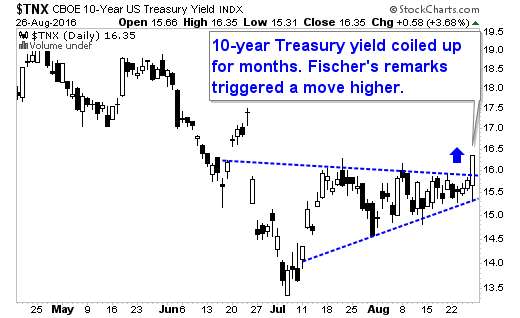
By the way, Fischer has a history of being full of baloney. The market doesn't remember, but last August he hinted strongly at a September rate hike and it never happened.
Where various Fed governors stand on rate hikes: LINK
Brad DeLong on what Fischer should have said. LINK

SC high school bans American flags at football game
http://wncn.com/2016/08/29/sc-high-school-bans-american-flags-at-football-game/
The principal of Travelers Rest High School released a statement Saturday afternoon after complaints on social media after a students were not allowed to bring American flags to a football game Friday night.
Saturday evening Greenville County Schools released a statement saying the district “encourages and supports the appropriate display of the United States Flag in accord with the United States Flag Code.”
The statement went on to say that the district, “[does] not condone the use of the Flag to shield unsportsmanlike or inappropriate conduct.”
Read the full statement below.
The principal of Travelers Rest High School released a statement Saturday afternoon after complaints on social media after a students were not allowed to bring American flags to a football game Friday night.
Saturday evening Greenville County Schools released a statement saying the district “encourages and supports the appropriate display of the United States Flag in accord with the United States Flag Code.”
The statement went on to say that the district, “[does] not condone the use of the Flag to shield unsportsmanlike or inappropriate conduct.”
Read the full statement below.
Trump To Launch Major Attack Ad Campaign Against Hillary; "She is a jobs killer"
http://hosted.ap.org/dynamic/stories/U/US_CAMPAIGN_2016_TRUMP_ADS?SITE=AP&SECTION=HOME&TEMPLATE=DEFAULT&CTIME=2016-08-29-11-06-51
Donald Trump's
campaign is making its biggest general election ad buy to date, with
plans to spend upward of $10 million on commercials airing over the next
week or so.
The campaign is expecting to air a
new ad, which paints rival Hillary Clinton as a job-killer, as soon as
Monday in nine states: Ohio, Pennsylvania, North Carolina and Florida,
where the campaign has already been on the air, along with New
Hampshire, Virginia, Iowa, Colorado and Nevada - all battleground
states.
German Savers Lose Faith in Banks, Stash Cash at Home
http://www.wsj.com/articles/german-savers-lose-faith-in-banks-stash-cash-at-home-1472485225
For years, Germans kept socking money away in savings accounts despite plunging interest rates. Savers deemed the accounts secure, and they still offered easy cash access. But recently, many have lost faith.
“It doesn’t pay to keep money in the bank, and on top of that you’re being taxed on it,” said Uwe Wiese, an 82-year-old pensioner who recently bought a home safe to stash roughly €53,000 ($59,344), including part of his company pension that he took as a payout.
Interest rates’ plunge into negative territory is now accelerating demand for impregnable metal boxes.
Burg-Waechter KG, Germany’s biggest safe manufacturer, posted a 25% jump in sales of home safes in the first half of this year compared with the year earlier, said sales chief Dietmar Schake, citing “significantly higher demand for safes by private individuals, mainly in Germany.”
For years, Germans kept socking money away in savings accounts despite plunging interest rates. Savers deemed the accounts secure, and they still offered easy cash access. But recently, many have lost faith.
“It doesn’t pay to keep money in the bank, and on top of that you’re being taxed on it,” said Uwe Wiese, an 82-year-old pensioner who recently bought a home safe to stash roughly €53,000 ($59,344), including part of his company pension that he took as a payout.
Interest rates’ plunge into negative territory is now accelerating demand for impregnable metal boxes.
Burg-Waechter KG, Germany’s biggest safe manufacturer, posted a 25% jump in sales of home safes in the first half of this year compared with the year earlier, said sales chief Dietmar Schake, citing “significantly higher demand for safes by private individuals, mainly in Germany.”
Nearly 10000 workers sue Chipotle for unpaid wages
http://money.cnn.com/2016/08/29/news/economy/chipotle-lawsuit-nearly-10000-workers/index.html
Current and former Chipotle (CMG) employees claim that the company made them work extra hours "off the clock" without paying them. It's a practice known as wage theft, and Chipotle is allegedly doing it all over the United States.
"Chipotle routinely requires hourly-paid restaurant
employees to punch out, and then continue working until they are given
permission to leave," according to the class action lawsuit known as
Turner v. Chipotle. It's named after a former Chipotle manager in
Colorado, Leah Turner, who claims she had to work without pay and was
told to make workers under her do the same in order to meet budget goals.
Current and former Chipotle (CMG) employees claim that the company made them work extra hours "off the clock" without paying them. It's a practice known as wage theft, and Chipotle is allegedly doing it all over the United States.
Slush funds to pay 'personal consultant' Huma Abedin, a $34,000 a night Caribbean holiday for daughter Chelsea and payoffs to silence Bill's sex accusers - How Hillary has used donations to the Clinton Foundation as her ‘personal piggy bank’
http://www.dailymail.co.uk/news/article-3659123/Slush-funds-pay-personal-consultant-Huma-Abedin-luxe-Caribbean-holiday-daughter-Chelsea-payoffs-silence-Bill-s-sex-accusers-Hillary-used-donations-Clinton-Foundation-personal-piggy-bank.html#ixzz4Ik4QSxJZ
The Clinton
Foundation is 'a vast, criminal conspiracy' and 'a slush fund for
grifters' with thousands of honest people who are victims after
contributing their hard-earned money to what they believed would be used
for philanthropic causes.
In
truth, the money that was donated to help earthquake victims in India
and Haiti and HIV/AIDs sufferers in the Third World has mostly enriched
the Clintons and their friends through scams spanning the globe, claims
author Jerome Corsi in his book, Partners in Crime: The Clintons' Scheme to Monetize the White House for Personal Profit, which will be published in August.
Driven
by insatiable greed while crying they were near-broke, the couple
schemed and Hillary used her position as secretary of state to leverage
lucrative deals for the Foundation as well as six-figure speaking fees
for Bill Clinton.
The
scheme engineered through the Foundation has enriched the Clintons by
hundreds of millions of dollars as well as adding $2billion to the
Clinton Foundation and raising $1billion for Hillary's second run for
the presidency, writes Corsi in his upcoming book.
Silver bull run just getting started: Tradebulls
http://www.financialexpress.com/markets/commodities/silver-bull-run-just-getting-started-tradebulls/357061/
It has been a good year for precious metals, particularly for gold and silver. If we look at gold, it has performed 28 per cent while silver has outshined gold and gained by nearly 40 per cent year to date. Investors have flocked to the metal in recent months, with hedge funds expanding their bullish bets on silver to an all-time high in May, as reported by Bloomberg. Silver demand appears to be increasing and supply appears to be decreasing. Another reason for gain in silver prices is continued low-rate stimulus by the Federal Reserve, European Central Bank (ECB) and Bank of Japan. Negative rates by ECB and Bank of Japan have supported expectation for continued monetary easing which is positive for bullion
It has been a good year for precious metals, particularly for gold and silver. If we look at gold, it has performed 28 per cent while silver has outshined gold and gained by nearly 40 per cent year to date. Investors have flocked to the metal in recent months, with hedge funds expanding their bullish bets on silver to an all-time high in May, as reported by Bloomberg. Silver demand appears to be increasing and supply appears to be decreasing. Another reason for gain in silver prices is continued low-rate stimulus by the Federal Reserve, European Central Bank (ECB) and Bank of Japan. Negative rates by ECB and Bank of Japan have supported expectation for continued monetary easing which is positive for bullion
Dallas Fed Manufacturing index lower in August at -6.2 vs -1.3 last month
Lower than expectations at -3.9

Earlier today, the Dallas
Fed Manufacturing index fell in the current month. This is report on the
state of the economy in the state of Texas. Texas has been a large
contributor to the economy in the US. Of course the state is large in
size and also large in energy, and cattle/farming and also in technology
(Dell is headquartered in the state) and other corporate businesses.
The
index fell to -6.2 in August vs. exepctations of -3.9 and -1.3 last
month. Below is a look at the details of the report. Although lower,
the numbers for the current month are mostly higher than the 6-month
averages. Which is a more positive trend.
Norwegian Central Bank Discloses Nearly $1 Billion in US Gold and Silver...
There's an awful lot of gold being accumulated by central banks.

Here are the gold and silver mining shares disclosed by Norges Bank and their values* as of June 30, 2015.
IMF’s ‘Substitution Fund’ to kick-start SDR as new global currency?
http://www.cdfund.com/wp-content/uploads/2016/08/SDR-Special-aug2016-DEF.pdf
After seven years of Chinese pressure, a plan allowing investors to exchange their U.S.
Treasury holdings for SDRs through a ‘substitution fund’ is being discussed
The Big Reset (2013) fully explains the need for a major reform of the world’s financial system.
At that time of publication, most people still had no clue what form the unfolding financial
endgame would take. A few years further on, and as interest rates have reached a level not seen
in 500 years, many are now starting to agree major monetary changes are needed urgently.
After seven years of Chinese pressure, a plan allowing investors to exchange their U.S.
Treasury holdings for SDRs through a ‘substitution fund’ is being discussed
The Big Reset (2013) fully explains the need for a major reform of the world’s financial system.
At that time of publication, most people still had no clue what form the unfolding financial
endgame would take. A few years further on, and as interest rates have reached a level not seen
in 500 years, many are now starting to agree major monetary changes are needed urgently.
Sunday, August 28, 2016
The warning
The founders specifically warned that Congress, backed by a standing
army, might one day move to disarm the American people, leaving citizens
toothless to oppose tyranny.
Are we witnessing the start of something the founders warned of?
Retired Army Gen. Peter Chiarelli is now among those campaigning for deeper layers of civilian gun control. At Time, Chiarelli writes he's now part of something called the Veterans Coalition for Common Sense:
Pretty damn bold. Chiarelli wraps himself in the Constitution while advocating infringement of both the Second Amendment and citizen rights to due process. The Constitution considers an accused person innocent until proven guilty. Chiarelli and his cohorts wish to begin infringing on citizens rights based on mere suspicions, some of which may not even risk to the level of triggering active law enforcement investigation.
The founders warned of guys like Chiarelli and his would-be rights-crushing cohorts.
Ever read Liberty or Empire by Patrick Henry? By some accounts, it's Henry's second most famous speech, saying in part:
We're now seeing an orchestrated move by political elites to un-do the constitutional safeguards the founders put in place, and that those who push for the un-doing count on dumbed-down Americans who fail to see what's falsely touted as common sense by today's political class and their allies would have been labeled by the founders as steps toward tyranny.
Are we witnessing the start of something the founders warned of?
Retired Army Gen. Peter Chiarelli is now among those campaigning for deeper layers of civilian gun control. At Time, Chiarelli writes he's now part of something called the Veterans Coalition for Common Sense:
Some of us are combat veterans. Some of us are gun owners. All of us were trained in the responsible use of firearms and to have respect for their incredible power. All of us swore an oath to defend our Constitution and to defend the homeland. And we all agree on this: our country is in the grips of a gun-violence crisis...The term common sense must resonate well with average folk and focus groups. That's probably why so many politicians use the term to accompany twisted words and bamboozling proposals that put our rights at risk.
The policies we support—closing the loopholes in our background check system and prohibiting known and suspected terrorists from legally buying guns—are not controversial. In fact, we are not asking our leaders to do anything that is not supported by the overwhelming majority of Americans, including gun owners. We are simply asking them to use common sense to save lives.
Pretty damn bold. Chiarelli wraps himself in the Constitution while advocating infringement of both the Second Amendment and citizen rights to due process. The Constitution considers an accused person innocent until proven guilty. Chiarelli and his cohorts wish to begin infringing on citizens rights based on mere suspicions, some of which may not even risk to the level of triggering active law enforcement investigation.
The founders warned of guys like Chiarelli and his would-be rights-crushing cohorts.
Ever read Liberty or Empire by Patrick Henry? By some accounts, it's Henry's second most famous speech, saying in part:
The honorable gentleman who presides told us that, to prevent abuses in our government, we will assemble in convention, recall our delegated powers, and punish our servants for abusing the trust reposed in them. Oh, sir! we should have fine times, indeed, if, to punish tyrants, it were only sufficient to assemble the people! Your arms, wherewith you could defend yourselves, are gone; and you have no longer an aristocratical, no longer a democratical spirit. Did you ever read of any revolution in a nation, brought about by the punishment of those in power, inflicted by those who had no power at all? You read of a riot act in a country which is called one of the freest in the world, where a few neighbors can not assemble without the risk of being shot by a hired soldiery, the engines of despotism. We may see such an act in America.Henry's speech was delivered in 1788 to the Virginia legislature testifying to his insistence that a Bill of Rights be included with ratification of the Constitution.
We're now seeing an orchestrated move by political elites to un-do the constitutional safeguards the founders put in place, and that those who push for the un-doing count on dumbed-down Americans who fail to see what's falsely touted as common sense by today's political class and their allies would have been labeled by the founders as steps toward tyranny.
Has the US Quietly Emptied the Denver Mint of Over 1,300 Tonnes of Gold?
https://www.bullionstar.com/blogs/ronan-manly/gold-bullion-stored-us-mint-denver/
[The Mint's Web site stated] "Today, the United States Mint at Denver manufactures all denominations of circulating coins, coin dies, the Denver "D" portion of the annual uncirculated coin sets and commemorative coins authorized by the U. S. Congress. It also stores gold and silver bullion."''... Less than a month later, on September 8, 2014, the above paragraph had been subtly changed to the following, and the words `gold and' had been removed...''
[The Mint's Web site stated] "Today, the United States Mint at Denver manufactures all denominations of circulating coins, coin dies, the Denver "D" portion of the annual uncirculated coin sets and commemorative coins authorized by the U. S. Congress. It also stores gold and silver bullion."''... Less than a month later, on September 8, 2014, the above paragraph had been subtly changed to the following, and the words `gold and' had been removed...''
Friday, August 26, 2016


Who's Pulling The Strings?
http://market-ticker.org/akcs-www?post=231481
It must be nice to have the ability to take otherwise taxable income and give it to your family friends while at the same time paying no taxes on it!
Now isn't that special?
All the screaming about Trump's tax return is a distraction which the media is more than willing to go along with by not focusing on the fact that Clinton really didn't give anything to charity at all; she and Bill instead abused the tax code to funnel "earnings" tax free to their family friends!
It must be nice to have the ability to take otherwise taxable income and give it to your family friends while at the same time paying no taxes on it!
Now isn't that special?
All the screaming about Trump's tax return is a distraction which the media is more than willing to go along with by not focusing on the fact that Clinton really didn't give anything to charity at all; she and Bill instead abused the tax code to funnel "earnings" tax free to their family friends!
Portugal Gets EU Approval to Inject $5 bln Into Ailing Bank
http://www.cnbc.com/2016/08/25/portugal-minister-on-bank-recap-plan-this-is-another-big-step-for-our-financial-system.html
The plan was agreed late on Tuesday afternoon. It would see Portugal pump up to 2.7 billion euros of state funds into Caixa, transfer 500 million euros of its ParCaixa shares to Caixa and convert 960 million euros of contingent convertible bonds into equity.
...
Meanwhile, Caixa will issue highly subordinated debt worth around 1.0 billion euros that will be compliant with regulatory capital ratios designed to bolster banks' ability to withstand financial shocks.
This follows negotiations with Brussels officials, aimed at ensuring the plan is not viewed as state-aid to the bank, which would add to Portugal's problematically high budget deficit.
Although the government would put money into the bank, the hope is that the returns for the state would outweigh the cash injection.
Uh-huh. Since now we're obviously about to go into an economic boom period, we're sure the Portuguese government will make money on this definitely-not-a-bailout cash injection...
The plan was agreed late on Tuesday afternoon. It would see Portugal pump up to 2.7 billion euros of state funds into Caixa, transfer 500 million euros of its ParCaixa shares to Caixa and convert 960 million euros of contingent convertible bonds into equity.
...
Meanwhile, Caixa will issue highly subordinated debt worth around 1.0 billion euros that will be compliant with regulatory capital ratios designed to bolster banks' ability to withstand financial shocks.
This follows negotiations with Brussels officials, aimed at ensuring the plan is not viewed as state-aid to the bank, which would add to Portugal's problematically high budget deficit.
Although the government would put money into the bank, the hope is that the returns for the state would outweigh the cash injection.
Uh-huh. Since now we're obviously about to go into an economic boom period, we're sure the Portuguese government will make money on this definitely-not-a-bailout cash injection...
Broken Chessboard: Brzezinski Gives Up on Empire
http://www.counterpunch.org/2016/08/25/the-broken-chessboard-brzezinski-gives-up-on-empire/
The main architect of Washington's plan to rule the world has abandoned the scheme and called for the forging of ties with Russia and China. While Zbigniew Brzezinski's article in The American Interest titled "Towards a Global Realignment" has largely been ignored by the media, it shows that powerful members of the policymaking establishment no longer believe that Washington will prevail in its quest to extent US hegemony across the Middle East and Asia. Brzezinski, who was the main proponent of this idea and who drew up the blueprint for imperial expansion in his 1997 book The Grand Chessboard: American Primacy and Its Geostrategic Imperatives, has done an about-face and called for a dramatic revising of the strategy.
...
Naturally, in a short 1,500-word article, Brzezniski can't cover all the challenges (or threats) the US might face in the future. But it's clear that what he's most worried about is the strengthening of economic, political and military ties between Russia, China, Iran, Turkey and the other Central Asian states.
The main architect of Washington's plan to rule the world has abandoned the scheme and called for the forging of ties with Russia and China. While Zbigniew Brzezinski's article in The American Interest titled "Towards a Global Realignment" has largely been ignored by the media, it shows that powerful members of the policymaking establishment no longer believe that Washington will prevail in its quest to extent US hegemony across the Middle East and Asia. Brzezinski, who was the main proponent of this idea and who drew up the blueprint for imperial expansion in his 1997 book The Grand Chessboard: American Primacy and Its Geostrategic Imperatives, has done an about-face and called for a dramatic revising of the strategy.
...
Naturally, in a short 1,500-word article, Brzezniski can't cover all the challenges (or threats) the US might face in the future. But it's clear that what he's most worried about is the strengthening of economic, political and military ties between Russia, China, Iran, Turkey and the other Central Asian states.
Blue State Blues: Fact-Check — Top 20 Lies in Hillary’s ‘Alt-Right’ Speech
http://www.breitbart.com/big-government/2016/08/26/blue-state-blues-fact-check-top-20-lies-hillarys-alt-right-speech/
Andrew added: “They need to marginalize and demonize those that would stand up to their hardball, toxic, and antidemocratic tactics … But it won’t work. Given a fair hearing, given just the slightest exposure — and the American people will rise to the occasion. They see these tactics for what they are.”
Conservatives will never be “given” a fair hearing. But I made sure I was personally on hand in Reno to hear Hillary Clinton’s lies, wearing my Breitbart shirt.
Andrew added: “They need to marginalize and demonize those that would stand up to their hardball, toxic, and antidemocratic tactics … But it won’t work. Given a fair hearing, given just the slightest exposure — and the American people will rise to the occasion. They see these tactics for what they are.”
Conservatives will never be “given” a fair hearing. But I made sure I was personally on hand in Reno to hear Hillary Clinton’s lies, wearing my Breitbart shirt.
Fed's Fischer: Yellen's comments are consistent with possible Sept hike
- Suggests rate hike this year is possible
- Economic picture is very complex
- Evidence is that the economy has strengthened
- We've had very strong hiring reports recently
- Inflation has been growing
- On employment, we're doing well
- Fed is not behind the curve on hikes
- Fiscal stimulus would be good for the economy
Donald Trump full interview w/ Anderson Cooper CNN today 8/25 – “She should be in jail. You know it, the FBI Director knows it, …”. Great interview, Anderson gives him time to talk, but CNN video people deceiving with the captions again.
Captions in order below. For reference, I quickly skipped through a
Clinton interview (same length) and it had about five changes… Trump was
covering nearly his entire platform in this interview.
TRUMP SHIFTS AGAIN ON IMMIGRATION
TRUMP: “WE’RE GOING TO BUILD A GREAT WALL”
TRUMP: “BAD DUDES” HERE ILLEGALLY WILL BE “OUT”
TRUMP: POLICE KNOW WHO THE “BAD DUDES” ARE
TRUMP: WE’RE GOING TO END SANCTUARY CITIES
TRUMP ON IMMIGRATION SHIFT: “I DON’T THINK IT’S A SOFTENING”
TRUMP ON ILLEGAL IMMIGRANTS: WE KNOW THE BAD ONES
TRUMP: NO PATH TO LEGALIZATION UNLESS THEY LEAVE AND COME BACK
TRUMP: WE’RE GOING TO GO WITH THE EXISTING LAWS
TRUMP: WE’RE GOING TO HAVE A STRONG BORDER
TRUMP: WE’RE GONNA STOP ALL DRUG TRAFFIC
TRUMP: THERE’S NO LEGALIZATION, NO AMNESTY
TRUMP DIGS IN ON BIGOTRY CLAIM ABOUT CLINTON
TRUMP: CLINTON IS “SELLING” AFRICAN AMERICANS “DOWN THE TUBES”
TRUMP: CLINTON’S POLICIES ARE BIGOTED BECAUSE SHE KNOWS THEY WON’T WORK
TRUMP: CLINTON HAS BEEN EXTREMELY BAD FOR AFRICAN AMERICANS, HISPANICS
TRUMP: WE’RE GOING TO DO WELL WITH AFRICAN AMERICANS
TRUMP: I DON’T THINK AFRICAN AMERICANS ARE INSULTED BY MY LANGUAGE
TRUMP: I CAN FIX THE INNER CITIES, CLINTON CAN’T
TRUMP RESPONDS TO CLINTON’S ALT-RIGHT ATTACKS
TRUMP: WE’RE BRINGING IN LOVE, NOT HATE
TRUMP ON ALT-RIGHT: I DON’T EVEN KNOW WHAT IT IS
TRUMP: CLINTON IS ALL TALK, NO ACTION
TRUMP ON RACIAL DISCRIMINATION LAWSUIT: THEY FOUND NOTHING
TRUMP: THEY SETTLED THE CASE, WE PAID NO MONEY
TRUMP SHIFTS AGAIN ON IMMIGRATION
TRUMP: “WE’RE GOING TO BUILD A GREAT WALL”
TRUMP: “BAD DUDES” HERE ILLEGALLY WILL BE “OUT”
TRUMP: POLICE KNOW WHO THE “BAD DUDES” ARE
TRUMP: WE’RE GOING TO END SANCTUARY CITIES
TRUMP ON IMMIGRATION SHIFT: “I DON’T THINK IT’S A SOFTENING”
TRUMP ON ILLEGAL IMMIGRANTS: WE KNOW THE BAD ONES
TRUMP: NO PATH TO LEGALIZATION UNLESS THEY LEAVE AND COME BACK
TRUMP: WE’RE GOING TO GO WITH THE EXISTING LAWS
TRUMP: WE’RE GOING TO HAVE A STRONG BORDER
TRUMP: WE’RE GONNA STOP ALL DRUG TRAFFIC
TRUMP: THERE’S NO LEGALIZATION, NO AMNESTY
TRUMP DIGS IN ON BIGOTRY CLAIM ABOUT CLINTON
TRUMP: CLINTON IS “SELLING” AFRICAN AMERICANS “DOWN THE TUBES”
TRUMP: CLINTON’S POLICIES ARE BIGOTED BECAUSE SHE KNOWS THEY WON’T WORK
TRUMP: CLINTON HAS BEEN EXTREMELY BAD FOR AFRICAN AMERICANS, HISPANICS
TRUMP: WE’RE GOING TO DO WELL WITH AFRICAN AMERICANS
TRUMP: I DON’T THINK AFRICAN AMERICANS ARE INSULTED BY MY LANGUAGE
TRUMP: I CAN FIX THE INNER CITIES, CLINTON CAN’T
TRUMP RESPONDS TO CLINTON’S ALT-RIGHT ATTACKS
TRUMP: WE’RE BRINGING IN LOVE, NOT HATE
TRUMP ON ALT-RIGHT: I DON’T EVEN KNOW WHAT IT IS
TRUMP: CLINTON IS ALL TALK, NO ACTION
TRUMP ON RACIAL DISCRIMINATION LAWSUIT: THEY FOUND NOTHING
TRUMP: THEY SETTLED THE CASE, WE PAID NO MONEY
Japan July consumer prices post biggest annual fall in three yrs (TIME FOR A NIRP DOUBLE-DOWN?)
http://www.reuters.com/article/us-japan-economy-cpi-idUSKCN111004
Japan's consumer prices fell in July by the most in more than three years as more firms delayed price hikes due to weak consumption, keeping the central bank under pressure to expand an already massive stimulus program.
The gloomy data reinforces a dominant market view that premier Shinzo Abe's stimulus program have failed to dislodge the deflationary mindset prevailing among businesses and consumers.
...
"Given how prices are behaving and how the BOJ is asked to cooperate with Abe to beat deflation, it's very hard to think the BOJ will unwind stimulus any time soon," said Takeshi Minami, chief economist at Norinchukin Research Institute.
"Instead, the September analysis will probably lay the grounds for a deepening of negative interest rates."
Japan's consumer prices fell in July by the most in more than three years as more firms delayed price hikes due to weak consumption, keeping the central bank under pressure to expand an already massive stimulus program.
The gloomy data reinforces a dominant market view that premier Shinzo Abe's stimulus program have failed to dislodge the deflationary mindset prevailing among businesses and consumers.
...
"Given how prices are behaving and how the BOJ is asked to cooperate with Abe to beat deflation, it's very hard to think the BOJ will unwind stimulus any time soon," said Takeshi Minami, chief economist at Norinchukin Research Institute.
"Instead, the September analysis will probably lay the grounds for a deepening of negative interest rates."
Yemen missiles hit facilities of Saudi oil giant Aramco
http://presstv.com/Detail/2016/08/26/481761/Yemen-Saudi-Arabia-Aramco
The retaliatory attack took place on Friday, hitting targets in Saudi Arabia’s Jizan region and causing considerable damage to the Aramco facilities there, Yemen’s al-Masirah television reported.
The Saudi military has been pounding Yemen since March last year to undermine Yemen’s Houthi Ansarullah movement and to restore power to the former president, Abd Rabbuh Mansur Hadi, a staunch ally of Riyadh.
Nearly 10,000 people, most of them civilians, have been killed in Riyadh’s military aggression which lacks any international mandate.
The retaliatory attack took place on Friday, hitting targets in Saudi Arabia’s Jizan region and causing considerable damage to the Aramco facilities there, Yemen’s al-Masirah television reported.
The Saudi military has been pounding Yemen since March last year to undermine Yemen’s Houthi Ansarullah movement and to restore power to the former president, Abd Rabbuh Mansur Hadi, a staunch ally of Riyadh.
Nearly 10,000 people, most of them civilians, have been killed in Riyadh’s military aggression which lacks any international mandate.
Full text of Yellen's speech at Jackson Hole August 26, 2016
The Global Financial Crisis and Great Recession posed daunting new
challenges for central banks around the world and spurred innovations in
the design, implementation, and communication of monetary policy. With
the U.S. economy now nearing the Federal Reserve's statutory goals of
maximum employment and price stability, this conference provides a
timely opportunity to consider how the lessons we learned are likely to
influence the conduct of monetary policy in the future.
The theme of the conference, "Designing Resilient Monetary Policy Frameworks for the Future," encompasses many aspects of monetary policy, from the nitty-gritty details of implementing policy in financial markets to broader questions about how policy affects the economy. Within the operational realm, key choices include the selection of policy instruments, the specific markets in which the central bank participates, and the size and structure of the central bank's balance sheet. These topics are of great importance to the Federal Reserve. As noted in the minutes of last month's Federal Open Market Committee (FOMC) meeting, we are studying many issues related to policy implementation, research which ultimately will inform the FOMC's views on how to most effectively conduct monetary policy in the years ahead. I expect that the work discussed at this conference will make valuable contributions to the understanding of many of these important issues.
My focus today will be the policy tools that are needed to ensure that we have a resilient monetary policy framework. In particular, I will focus on whether our existing tools are adequate to respond to future economic downturns. As I will argue, one lesson from the crisis is that our pre-crisis toolkit was inadequate to address the range of economic circumstances that we faced. Looking ahead, we will likely need to retain many of the monetary policy tools that were developed to promote recovery from the crisis. In addition, policymakers inside and outside the Fed may wish at some point to consider additional options to secure a strong and resilient economy. But before I turn to these longer-run issues, I would like to offer a few remarks on the near-term outlook for the U.S. economy and the potential implications for monetary policy.
Current Economic Situation and Outlook
U.S. economic activity continues to expand, led by solid growth in household spending. But business investment remains soft and subdued foreign demand and the appreciation of the dollar since mid-2014 continue to restrain exports. While economic growth has not been rapid, it has been sufficient to generate further improvement in the labor market. Smoothing through the monthly ups and downs, job gains averaged 190,000 per month over the past three months. Although the unemployment rate has remained fairly steady this year, near 5 percent, broader measures of labor utilization have improved. Inflation has continued to run below the FOMC's objective of 2 percent, reflecting in part the transitory effects of earlier declines in energy and import prices.
Looking ahead, the FOMC expects moderate growth in real gross domestic product (GDP), additional strengthening in the labor market, and inflation rising to 2 percent over the next few years. Based on this economic outlook, the FOMC continues to anticipate that gradual increases in the federal funds rate will be appropriate over time to achieve and sustain employment and inflation near our statutory objectives. Indeed, in light of the continued solid performance of the labor market and our outlook for economic activity and inflation, I believe the case for an increase in the federal funds rate has strengthened in recent months. Of course, our decisions always depend on the degree to which incoming data continues to confirm the Committee's outlook.
And, as ever, the economic outlook is uncertain, and so monetary policy is not on a preset course. Our ability to predict how the federal funds rate will evolve over time is quite limited because monetary policy will need to respond to whatever disturbances may buffet the economy. In addition, the level of short-term interest rates consistent with the dual mandate varies over time in response to shifts in underlying economic conditions that are often evident only in hindsight. For these reasons, the range of reasonably likely outcomes for the federal funds rate is quite wide--a point illustrated by figure 1 in your handout. The line in the center is the median path for the federal funds rate based on the FOMC's Summary of Economic Projections in June.1 The shaded region, which is based on the historical accuracy of private and government forecasters, shows a 70 percent probability that the federal funds rate will be between 0 and 3-1/4 percent at the end of next year and between 0 and 4-1/2 percent at the end of 2018.2 The reason for the wide range is that the economy is frequently buffeted by shocks and thus rarely evolves as predicted. When shocks occur and the economic outlook changes, monetary policy needs to adjust. What we do know, however, is that we want a policy toolkit that will allow us to respond to a wide range of possible conditions.
The Pre-Crisis Toolkit
Prior to the financial crisis, the Federal Reserve's monetary policy toolkit was simple but effective in the circumstances that then prevailed. Our main tool consisted of open market operations to manage the amount of reserve balances available to the banking sector.3 These operations, in turn, influenced the interest rate in the federal funds market, where banks experiencing reserve shortfalls could borrow from banks with excess reserves. Before the onset of the crisis, the volume of reserves was generally small--only about $45 billion or so.4 Thus, even small open market operations could have a significant effect on the federal funds rate. Changes in the federal funds rate would then be transmitted to other short-term interest rates, affecting longer-term interest rates and overall financial conditions and hence inflation and economic activity. This simple, light-touch system allowed the Federal Reserve to operate with a relatively small balance sheet--less than $1 trillion before the crisis--the size of which was largely determined by the need to supply enough U.S. currency to meet demand.5
The global financial crisis revealed two main shortcomings of this simple toolkit. The first was an inability to control the federal funds rate once reserves were no longer relatively scarce. Starting in late 2007, faced with acute financial market distress, the Federal Reserve created programs to keep credit flowing to households and businesses.6 The loans extended under those programs helped stabilize the financial system. But the additional reserves created by these programs, if left unchecked, would have pushed down the federal funds rate, driving it well below the FOMC's target. To prevent such an outcome, the Federal Reserve took several steps to offset (or sterilize) the effect of its liquidity and credit operations on reserves.7 By the fall of 2008, however, the reserve effects of our liquidity and credit programs threatened to become too large to sterilize via asset sales and other existing tools. Without sufficient sterilization capacity, the quantity of reserves increased to a point that the Federal Reserve had difficulty maintaining effective control over the federal funds rate.
Of course, by the end of 2008, stabilizing the federal funds rate at a level materially above zero was not an immediate concern because the economy clearly needed very low short-term interest rates. Faced with a steep rise in unemployment and declining inflation, the FOMC lowered its target for the federal funds rate to near zero, a reduction of roughly 5 percentage points over the previous year and a half. Nonetheless, a variety of policy benchmarks would, at least in hindsight, have called for pushing the federal funds rate well below zero during the economic downturn.8 That doing so was impossible highlights the second serious limitation of our pre-crisis policy toolkit: its inability to generate substantially more accommodation than could be provided by a near-zero federal funds rate.
Our Expanded Toolkit
To address the challenges posed by the financial crisis and the subsequent severe recession and slow recovery, the Federal Reserve significantly expanded its monetary policy toolkit. In 2006, the Congress had approved plans to allow the Fed, beginning in 2011, to pay interest on banks' reserve balances.9 In the fall of 2008, the Congress moved up the effective date of this authority to October 2008. That authority was essential. Paying interest on reserve balances enables the Fed to break the strong link between the quantity of reserves and the level of the federal funds rate and, in turn, allows the Federal Reserve to control short-term interest rates when reserves are plentiful. In particular, once economic conditions warrant a higher level for market interest rates, the Federal Reserve could raise the interest rate paid on excess reserves--the IOER rate. A higher IOER rate encourages banks to raise the interest rates they charge, putting upward pressure on market interest rates regardless of the level of reserves in the banking sector.
While adjusting the IOER rate is an effective way to move market interest rates when reserves are plentiful, federal funds have generally traded below this rate. This relative softness of the federal funds rate reflects, in part, the fact that only depository institutions can earn the IOER rate. To put a more effective floor under short-term interest rates, the Federal Reserve created supplementary tools to be used as needed. For instance, the overnight reverse repurchase agreement (ON RRP) facility is available to a variety of counterparties, including eligible money market funds, government-sponsored enterprises, broker-dealers, and depository institutions. Through it, eligible counterparties may invest funds overnight with the Federal Reserve at a rate determined by the FOMC. Similar to the payment of IOER, the ON RRP facility discourages participating institutions from lending at a rate substantially below that offered by the Fed.10
Our current toolkit proved effective last December. In an environment of superabundant reserves, the FOMC raised the effective federal funds rate--that is, the weighted average rate on federal funds transactions among participants in that market--by the desired amount, and we have since maintained the federal funds rate in its target range.
Two other major additions to the Fed's toolkit were large-scale asset purchases and increasingly explicit forward guidance.11 Both were used to provide additional monetary policy accommodation after short-term interest rates fell close to zero. Our purchases of Treasury and mortgage-related securities in the open market pushed down longer-term borrowing rates for millions of American families and businesses. Extended forward rate guidance--announcing that we intended to keep short-term interest rates lower for longer than might have otherwise been expected--also put significant downward pressure on longer-term borrowing rates, as did guidance regarding the size and scope of our asset purchases.
In light of the slowness of the economic recovery, some have questioned the effectiveness of asset purchases and extended forward rate guidance. But this criticism fails to consider the unusual headwinds the economy faced after the crisis. Those headwinds included substantial household and business deleveraging, unfavorable demand shocks from abroad, a period of contractionary fiscal policy, and unusually tight credit, especially for housing. Studies have found that our asset purchases and extended forward rate guidance put appreciable downward pressure on long-term interest rates and, as a result, helped spur growth in demand for goods and services, lower the unemployment rate, and prevent inflation from falling further below our 2 percent objective.12
Two of the Fed's most important new tools--our authority to pay interest on excess reserves and our asset purchases--interacted importantly. Without IOER authority, the Federal Reserve would have been reluctant to buy as many assets as it did because of the longer-run implications for controlling the stance of monetary policy. While we were buying assets aggressively to help bring the U.S. economy out of a severe recession, we also had to keep in mind whether and how we would be able to remove monetary policy accommodation when appropriate. That issue was particularly relevant because we fund our asset purchases through the creation of reserves, and those additional reserves would have made it ever more difficult for the pre-crisis toolkit to raise short-term interest rates when needed.
The FOMC considered removing accommodation by first reducing our asset holdings (including through asset sales) and raising the federal funds rate only after our balance sheet had contracted substantially. But we decided against this approach because our ability to predict the effects of changes in the balance sheet on the economy is less than that associated with changes in the federal funds rate. Excessive inflationary pressures could arise if assets were sold too slowly. Conversely, financial markets and the economy could potentially be destabilized if assets were sold too aggressively. Indeed, the so-called taper tantrum of 2013 illustrates the difficulty of predicting financial market reactions to announcements about the balance sheet. Given the uncertainty and potential costs associated with large-scale asset sales, the FOMC instead decided to begin removing monetary policy accommodation primarily by adjusting short-term interest rates rather than by actively managing its asset holdings.13 That strategy--raising short-term interest rates once the recovery was sufficiently advanced while maintaining a relatively large balance sheet and plentiful bank reserves--depended on our ability to pay interest on excess reserves.
Where Do We Go from Here?
What does the future hold for the Fed's toolkit? For starters, our ability to use interest on reserves is likely to play a key role for years to come. In part, this reflects the outlook for our balance sheet over the next few years. As the FOMC has noted in its recent statements, at some point after the process of raising the federal funds rate is well under way, we will cease or phase out reinvesting repayments of principal from our securities holdings. Once we stop reinvestment, it should take several years for our asset holdings--and the bank reserves used to finance them--to passively decline to a more normal level. But even after the volume of reserves falls substantially, IOER will still be important as a contingency tool, because we may need to purchase assets during future recessions to supplement conventional interest rate reductions.14 Forecasts now show the federal funds rate settling at about 3 percent in the longer run.15 In contrast, the federal funds rate averaged more than 7 percent between 1965 and 2000. Thus, we expect to have less scope for interest rate cuts than we have had historically.
In part, current expectations for a low future federal funds rate reflect the FOMC's success in stabilizing inflation at around 2 percent--a rate much lower than rates that prevailed during the 1970s and 1980s. Another key factor is the marked decline over the past decade, both here and abroad, in the long-run neutral real rate of interest--that is, the inflation-adjusted short-term interest rate consistent with keeping output at its potential on average over time.16 Several developments could have contributed to this apparent decline, including slower growth in the working-age populations of many countries, smaller productivity gains in the advanced economies, a decreased propensity to spend in the wake of the financial crises around the world since the late 1990s, and perhaps a paucity of attractive capital projects worldwide.17 Although these factors may help explain why bond yields have fallen to such low levels here and abroad, our understanding of the forces driving long-run trends in interest rates is nevertheless limited, and thus all predictions in this area are highly uncertain.18
Would an average federal funds rate of about 3 percent impair the Fed's ability to fight recessions? Based on the FOMC's behavior in past recessions, one might think that such a low interest rate could substantially impair policy effectiveness. As shown in the first column of the table in the handout, during the past nine recessions, the FOMC cut the federal funds rate by amounts ranging from about 3 percentage points to more than 10 percentage points. On average, the FOMC reduced rates by about 5-1/2 percentage points, which seems to suggest that the FOMC would face a shortfall of about 2-1/2 percentage points for dealing with an average-sized recession. But this simple comparison exaggerates the limitations on policy created by the zero lower bound. As shown in the second column, the federal funds rate at the start of the past seven recessions was appreciably above the level consistent with the economy operating at potential in the longer run. In most cases, this tighter-than-normal stance of policy before the recession appears to have reflected some combination of initially higher-than-normal labor utilization and elevated inflation pressures. As a result, a large portion of the rate cuts that subsequently occurred during these recessions represented the undoing of the earlier tight stance of monetary policy. Of course, this situation could occur again in the future. But if it did, the federal funds rate at the onset of the recession would be well above its normal level, and the FOMC would be able to cut short-term interest rates by substantially more than 3 percentage points.
A recent paper takes a different approach to assessing the FOMC's ability to respond to future recessions by using simulations of the FRB/US model.19 This analysis begins by asking how the economy would respond to a set of highly adverse shocks if policymakers followed a fairly aggressive policy rule, hypothetically assuming that they can cut the federal funds rate without limit.20 It then imposes the zero lower bound and asks whether some combination of forward guidance and asset purchases would be sufficient to generate economic conditions at least as good as those that occur under the hypothetical unconstrained policy. In general, the study concludes that, even if the average level of the federal funds rate in the future is only 3 percent, these new tools should be sufficient unless the recession were to be unusually severe and persistent.
Figure 2 in your handout illustrates this point. It shows simulated paths for interest rates, the unemployment rate, and inflation under three different monetary policy responses--the aggressive rule in the absence of the zero lower bound constraint, the constrained aggressive rule, and the constrained aggressive rule combined with $2 trillion in asset purchases and guidance that the federal funds rate will depart from the rule by staying lower for longer.21 As the blue dashed line shows, the federal funds rate would fall far below zero if policy were unconstrained, thereby causing long-term interest rates to fall sharply. But despite the lower bound, asset purchases and forward guidance can push long-term interest rates even lower on average than in the unconstrained case (especially when adjusted for inflation) by reducing term premiums and increasing the downward pressure on the expected average value of future short-term interest rates. Thus, the use of such tools could result in even better outcomes for unemployment and inflation on average.
Of course, this analysis could be too optimistic. For one, the FRB/US simulations may overstate the effectiveness of forward guidance and asset purchases, particularly in an environment where long-term interest rates are also likely to be unusually low.22 In addition, policymakers could have less ability to cut short-term interest rates in the future than the simulations assume. By some calculations, the real neutral rate is currently close to zero, and it could remain at this low level if we were to continue to see slow productivity growth and high global saving.23 If so, then the average level of the nominal federal funds rate down the road might turn out to be only 2 percent, implying that asset purchases and forward guidance might have to be pushed to extremes to compensate.24 Moreover, relying too heavily on these nontraditional tools could have unintended consequences. For example, if future policymakers responded to a severe recession by announcing their intention to keep the federal funds rate near zero for a very long time after the economy had substantially recovered and followed through on that guidance, then they might inadvertently encourage excessive risk-taking and so undermine financial stability.
Finally, the simulation analysis certainly overstates the FOMC's current ability to respond to a recession, given that there is little scope to cut the federal funds rate at the moment. But that does not mean that the Federal Reserve would be unable to provide appreciable accommodation should the ongoing expansion falter in the near term. In addition to taking the federal funds rate back down to nearly zero, the FOMC could resume asset purchases and announce its intention to keep the federal funds rate at this level until conditions had improved markedly--although with long-term interest rates already quite low, the net stimulus that would result might be somewhat reduced.
Despite these caveats, I expect that forward guidance and asset purchases will remain important components of the Fed's policy toolkit. In addition, it is critical that the Federal Reserve and other supervisory agencies continue to do all they can to ensure a strong and resilient financial system. That said, these tools are not a panacea, and future policymakers could find that they are not adequate to deal with deep and prolonged economic downturns. For these reasons, policymakers and society more broadly may want to explore additional options for helping to foster a strong economy.
On the monetary policy side, future policymakers might choose to consider some additional tools that have been employed by other central banks, though adding them to our toolkit would require a very careful weighing of costs and benefits and, in some cases, could require legislation. For example, future policymakers may wish to explore the possibility of purchasing a broader range of assets. Beyond that, some observers have suggested raising the FOMC's 2 percent inflation objective or implementing policy through alternative monetary policy frameworks, such as price-level or nominal GDP targeting. I should stress, however, that the FOMC is not actively considering these additional tools and policy frameworks, although they are important subjects for research.
Beyond monetary policy, fiscal policy has traditionally played an important role in dealing with severe economic downturns. A wide range of possible fiscal policy tools and approaches could enhance the cyclical stability of the economy.25 For example, steps could be taken to increase the effectiveness of the automatic stabilizers, and some economists have proposed that greater fiscal support could be usefully provided to state and local governments during recessions. As always, it would be important to ensure that any fiscal policy changes did not compromise long-run fiscal sustainability.
Finally, and most ambitiously, as a society we should explore ways to raise productivity growth. Stronger productivity growth would tend to raise the average level of interest rates and therefore would provide the Federal Reserve with greater scope to ease monetary policy in the event of a recession. But more importantly, stronger productivity growth would enhance Americans' living standards. Though outside the narrow field of monetary policy, many possibilities in this arena are worth considering, including improving our educational system and investing more in worker training; promoting capital investment and research spending, both private and public; and looking for ways to reduce regulatory burdens while protecting important economic, financial, and social goals.
Conclusion
Although fiscal policies and structural reforms can play an important role in strengthening the U.S. economy, my primary message today is that I expect monetary policy will continue to play a vital part in promoting a stable and healthy economy. New policy tools, which helped the Federal Reserve respond to the financial crisis and Great Recession, are likely to remain useful in dealing with future downturns. Additional tools may be needed and will be the subject of research and debate. But even if average interest rates remain lower than in the past, I believe that monetary policy will, under most conditions, be able to respond effectively.
The theme of the conference, "Designing Resilient Monetary Policy Frameworks for the Future," encompasses many aspects of monetary policy, from the nitty-gritty details of implementing policy in financial markets to broader questions about how policy affects the economy. Within the operational realm, key choices include the selection of policy instruments, the specific markets in which the central bank participates, and the size and structure of the central bank's balance sheet. These topics are of great importance to the Federal Reserve. As noted in the minutes of last month's Federal Open Market Committee (FOMC) meeting, we are studying many issues related to policy implementation, research which ultimately will inform the FOMC's views on how to most effectively conduct monetary policy in the years ahead. I expect that the work discussed at this conference will make valuable contributions to the understanding of many of these important issues.
My focus today will be the policy tools that are needed to ensure that we have a resilient monetary policy framework. In particular, I will focus on whether our existing tools are adequate to respond to future economic downturns. As I will argue, one lesson from the crisis is that our pre-crisis toolkit was inadequate to address the range of economic circumstances that we faced. Looking ahead, we will likely need to retain many of the monetary policy tools that were developed to promote recovery from the crisis. In addition, policymakers inside and outside the Fed may wish at some point to consider additional options to secure a strong and resilient economy. But before I turn to these longer-run issues, I would like to offer a few remarks on the near-term outlook for the U.S. economy and the potential implications for monetary policy.
Current Economic Situation and Outlook
U.S. economic activity continues to expand, led by solid growth in household spending. But business investment remains soft and subdued foreign demand and the appreciation of the dollar since mid-2014 continue to restrain exports. While economic growth has not been rapid, it has been sufficient to generate further improvement in the labor market. Smoothing through the monthly ups and downs, job gains averaged 190,000 per month over the past three months. Although the unemployment rate has remained fairly steady this year, near 5 percent, broader measures of labor utilization have improved. Inflation has continued to run below the FOMC's objective of 2 percent, reflecting in part the transitory effects of earlier declines in energy and import prices.
Looking ahead, the FOMC expects moderate growth in real gross domestic product (GDP), additional strengthening in the labor market, and inflation rising to 2 percent over the next few years. Based on this economic outlook, the FOMC continues to anticipate that gradual increases in the federal funds rate will be appropriate over time to achieve and sustain employment and inflation near our statutory objectives. Indeed, in light of the continued solid performance of the labor market and our outlook for economic activity and inflation, I believe the case for an increase in the federal funds rate has strengthened in recent months. Of course, our decisions always depend on the degree to which incoming data continues to confirm the Committee's outlook.
And, as ever, the economic outlook is uncertain, and so monetary policy is not on a preset course. Our ability to predict how the federal funds rate will evolve over time is quite limited because monetary policy will need to respond to whatever disturbances may buffet the economy. In addition, the level of short-term interest rates consistent with the dual mandate varies over time in response to shifts in underlying economic conditions that are often evident only in hindsight. For these reasons, the range of reasonably likely outcomes for the federal funds rate is quite wide--a point illustrated by figure 1 in your handout. The line in the center is the median path for the federal funds rate based on the FOMC's Summary of Economic Projections in June.1 The shaded region, which is based on the historical accuracy of private and government forecasters, shows a 70 percent probability that the federal funds rate will be between 0 and 3-1/4 percent at the end of next year and between 0 and 4-1/2 percent at the end of 2018.2 The reason for the wide range is that the economy is frequently buffeted by shocks and thus rarely evolves as predicted. When shocks occur and the economic outlook changes, monetary policy needs to adjust. What we do know, however, is that we want a policy toolkit that will allow us to respond to a wide range of possible conditions.
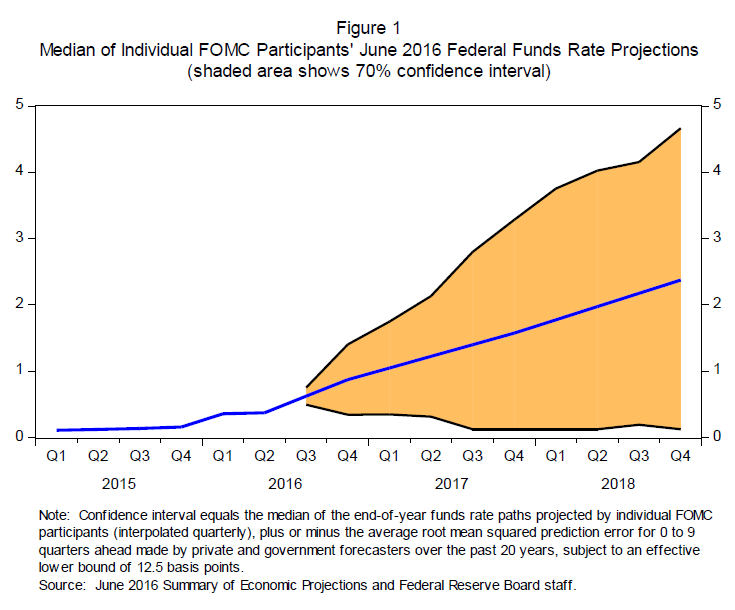
The Pre-Crisis Toolkit
Prior to the financial crisis, the Federal Reserve's monetary policy toolkit was simple but effective in the circumstances that then prevailed. Our main tool consisted of open market operations to manage the amount of reserve balances available to the banking sector.3 These operations, in turn, influenced the interest rate in the federal funds market, where banks experiencing reserve shortfalls could borrow from banks with excess reserves. Before the onset of the crisis, the volume of reserves was generally small--only about $45 billion or so.4 Thus, even small open market operations could have a significant effect on the federal funds rate. Changes in the federal funds rate would then be transmitted to other short-term interest rates, affecting longer-term interest rates and overall financial conditions and hence inflation and economic activity. This simple, light-touch system allowed the Federal Reserve to operate with a relatively small balance sheet--less than $1 trillion before the crisis--the size of which was largely determined by the need to supply enough U.S. currency to meet demand.5
The global financial crisis revealed two main shortcomings of this simple toolkit. The first was an inability to control the federal funds rate once reserves were no longer relatively scarce. Starting in late 2007, faced with acute financial market distress, the Federal Reserve created programs to keep credit flowing to households and businesses.6 The loans extended under those programs helped stabilize the financial system. But the additional reserves created by these programs, if left unchecked, would have pushed down the federal funds rate, driving it well below the FOMC's target. To prevent such an outcome, the Federal Reserve took several steps to offset (or sterilize) the effect of its liquidity and credit operations on reserves.7 By the fall of 2008, however, the reserve effects of our liquidity and credit programs threatened to become too large to sterilize via asset sales and other existing tools. Without sufficient sterilization capacity, the quantity of reserves increased to a point that the Federal Reserve had difficulty maintaining effective control over the federal funds rate.
Of course, by the end of 2008, stabilizing the federal funds rate at a level materially above zero was not an immediate concern because the economy clearly needed very low short-term interest rates. Faced with a steep rise in unemployment and declining inflation, the FOMC lowered its target for the federal funds rate to near zero, a reduction of roughly 5 percentage points over the previous year and a half. Nonetheless, a variety of policy benchmarks would, at least in hindsight, have called for pushing the federal funds rate well below zero during the economic downturn.8 That doing so was impossible highlights the second serious limitation of our pre-crisis policy toolkit: its inability to generate substantially more accommodation than could be provided by a near-zero federal funds rate.
Our Expanded Toolkit
To address the challenges posed by the financial crisis and the subsequent severe recession and slow recovery, the Federal Reserve significantly expanded its monetary policy toolkit. In 2006, the Congress had approved plans to allow the Fed, beginning in 2011, to pay interest on banks' reserve balances.9 In the fall of 2008, the Congress moved up the effective date of this authority to October 2008. That authority was essential. Paying interest on reserve balances enables the Fed to break the strong link between the quantity of reserves and the level of the federal funds rate and, in turn, allows the Federal Reserve to control short-term interest rates when reserves are plentiful. In particular, once economic conditions warrant a higher level for market interest rates, the Federal Reserve could raise the interest rate paid on excess reserves--the IOER rate. A higher IOER rate encourages banks to raise the interest rates they charge, putting upward pressure on market interest rates regardless of the level of reserves in the banking sector.
While adjusting the IOER rate is an effective way to move market interest rates when reserves are plentiful, federal funds have generally traded below this rate. This relative softness of the federal funds rate reflects, in part, the fact that only depository institutions can earn the IOER rate. To put a more effective floor under short-term interest rates, the Federal Reserve created supplementary tools to be used as needed. For instance, the overnight reverse repurchase agreement (ON RRP) facility is available to a variety of counterparties, including eligible money market funds, government-sponsored enterprises, broker-dealers, and depository institutions. Through it, eligible counterparties may invest funds overnight with the Federal Reserve at a rate determined by the FOMC. Similar to the payment of IOER, the ON RRP facility discourages participating institutions from lending at a rate substantially below that offered by the Fed.10
Our current toolkit proved effective last December. In an environment of superabundant reserves, the FOMC raised the effective federal funds rate--that is, the weighted average rate on federal funds transactions among participants in that market--by the desired amount, and we have since maintained the federal funds rate in its target range.
Two other major additions to the Fed's toolkit were large-scale asset purchases and increasingly explicit forward guidance.11 Both were used to provide additional monetary policy accommodation after short-term interest rates fell close to zero. Our purchases of Treasury and mortgage-related securities in the open market pushed down longer-term borrowing rates for millions of American families and businesses. Extended forward rate guidance--announcing that we intended to keep short-term interest rates lower for longer than might have otherwise been expected--also put significant downward pressure on longer-term borrowing rates, as did guidance regarding the size and scope of our asset purchases.
In light of the slowness of the economic recovery, some have questioned the effectiveness of asset purchases and extended forward rate guidance. But this criticism fails to consider the unusual headwinds the economy faced after the crisis. Those headwinds included substantial household and business deleveraging, unfavorable demand shocks from abroad, a period of contractionary fiscal policy, and unusually tight credit, especially for housing. Studies have found that our asset purchases and extended forward rate guidance put appreciable downward pressure on long-term interest rates and, as a result, helped spur growth in demand for goods and services, lower the unemployment rate, and prevent inflation from falling further below our 2 percent objective.12
Two of the Fed's most important new tools--our authority to pay interest on excess reserves and our asset purchases--interacted importantly. Without IOER authority, the Federal Reserve would have been reluctant to buy as many assets as it did because of the longer-run implications for controlling the stance of monetary policy. While we were buying assets aggressively to help bring the U.S. economy out of a severe recession, we also had to keep in mind whether and how we would be able to remove monetary policy accommodation when appropriate. That issue was particularly relevant because we fund our asset purchases through the creation of reserves, and those additional reserves would have made it ever more difficult for the pre-crisis toolkit to raise short-term interest rates when needed.
The FOMC considered removing accommodation by first reducing our asset holdings (including through asset sales) and raising the federal funds rate only after our balance sheet had contracted substantially. But we decided against this approach because our ability to predict the effects of changes in the balance sheet on the economy is less than that associated with changes in the federal funds rate. Excessive inflationary pressures could arise if assets were sold too slowly. Conversely, financial markets and the economy could potentially be destabilized if assets were sold too aggressively. Indeed, the so-called taper tantrum of 2013 illustrates the difficulty of predicting financial market reactions to announcements about the balance sheet. Given the uncertainty and potential costs associated with large-scale asset sales, the FOMC instead decided to begin removing monetary policy accommodation primarily by adjusting short-term interest rates rather than by actively managing its asset holdings.13 That strategy--raising short-term interest rates once the recovery was sufficiently advanced while maintaining a relatively large balance sheet and plentiful bank reserves--depended on our ability to pay interest on excess reserves.
Where Do We Go from Here?
What does the future hold for the Fed's toolkit? For starters, our ability to use interest on reserves is likely to play a key role for years to come. In part, this reflects the outlook for our balance sheet over the next few years. As the FOMC has noted in its recent statements, at some point after the process of raising the federal funds rate is well under way, we will cease or phase out reinvesting repayments of principal from our securities holdings. Once we stop reinvestment, it should take several years for our asset holdings--and the bank reserves used to finance them--to passively decline to a more normal level. But even after the volume of reserves falls substantially, IOER will still be important as a contingency tool, because we may need to purchase assets during future recessions to supplement conventional interest rate reductions.14 Forecasts now show the federal funds rate settling at about 3 percent in the longer run.15 In contrast, the federal funds rate averaged more than 7 percent between 1965 and 2000. Thus, we expect to have less scope for interest rate cuts than we have had historically.
In part, current expectations for a low future federal funds rate reflect the FOMC's success in stabilizing inflation at around 2 percent--a rate much lower than rates that prevailed during the 1970s and 1980s. Another key factor is the marked decline over the past decade, both here and abroad, in the long-run neutral real rate of interest--that is, the inflation-adjusted short-term interest rate consistent with keeping output at its potential on average over time.16 Several developments could have contributed to this apparent decline, including slower growth in the working-age populations of many countries, smaller productivity gains in the advanced economies, a decreased propensity to spend in the wake of the financial crises around the world since the late 1990s, and perhaps a paucity of attractive capital projects worldwide.17 Although these factors may help explain why bond yields have fallen to such low levels here and abroad, our understanding of the forces driving long-run trends in interest rates is nevertheless limited, and thus all predictions in this area are highly uncertain.18
Would an average federal funds rate of about 3 percent impair the Fed's ability to fight recessions? Based on the FOMC's behavior in past recessions, one might think that such a low interest rate could substantially impair policy effectiveness. As shown in the first column of the table in the handout, during the past nine recessions, the FOMC cut the federal funds rate by amounts ranging from about 3 percentage points to more than 10 percentage points. On average, the FOMC reduced rates by about 5-1/2 percentage points, which seems to suggest that the FOMC would face a shortfall of about 2-1/2 percentage points for dealing with an average-sized recession. But this simple comparison exaggerates the limitations on policy created by the zero lower bound. As shown in the second column, the federal funds rate at the start of the past seven recessions was appreciably above the level consistent with the economy operating at potential in the longer run. In most cases, this tighter-than-normal stance of policy before the recession appears to have reflected some combination of initially higher-than-normal labor utilization and elevated inflation pressures. As a result, a large portion of the rate cuts that subsequently occurred during these recessions represented the undoing of the earlier tight stance of monetary policy. Of course, this situation could occur again in the future. But if it did, the federal funds rate at the onset of the recession would be well above its normal level, and the FOMC would be able to cut short-term interest rates by substantially more than 3 percentage points.
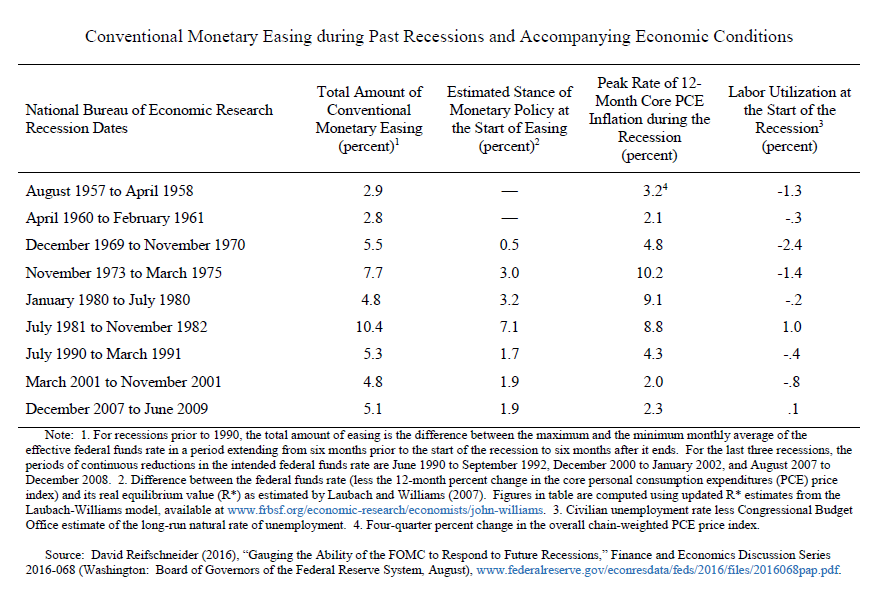
A recent paper takes a different approach to assessing the FOMC's ability to respond to future recessions by using simulations of the FRB/US model.19 This analysis begins by asking how the economy would respond to a set of highly adverse shocks if policymakers followed a fairly aggressive policy rule, hypothetically assuming that they can cut the federal funds rate without limit.20 It then imposes the zero lower bound and asks whether some combination of forward guidance and asset purchases would be sufficient to generate economic conditions at least as good as those that occur under the hypothetical unconstrained policy. In general, the study concludes that, even if the average level of the federal funds rate in the future is only 3 percent, these new tools should be sufficient unless the recession were to be unusually severe and persistent.
Figure 2 in your handout illustrates this point. It shows simulated paths for interest rates, the unemployment rate, and inflation under three different monetary policy responses--the aggressive rule in the absence of the zero lower bound constraint, the constrained aggressive rule, and the constrained aggressive rule combined with $2 trillion in asset purchases and guidance that the federal funds rate will depart from the rule by staying lower for longer.21 As the blue dashed line shows, the federal funds rate would fall far below zero if policy were unconstrained, thereby causing long-term interest rates to fall sharply. But despite the lower bound, asset purchases and forward guidance can push long-term interest rates even lower on average than in the unconstrained case (especially when adjusted for inflation) by reducing term premiums and increasing the downward pressure on the expected average value of future short-term interest rates. Thus, the use of such tools could result in even better outcomes for unemployment and inflation on average.
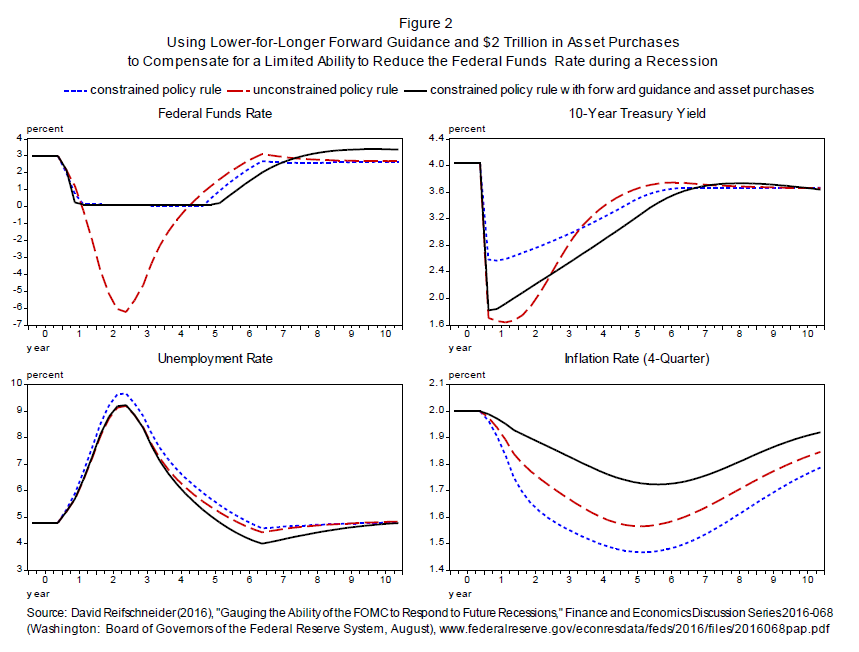
Of course, this analysis could be too optimistic. For one, the FRB/US simulations may overstate the effectiveness of forward guidance and asset purchases, particularly in an environment where long-term interest rates are also likely to be unusually low.22 In addition, policymakers could have less ability to cut short-term interest rates in the future than the simulations assume. By some calculations, the real neutral rate is currently close to zero, and it could remain at this low level if we were to continue to see slow productivity growth and high global saving.23 If so, then the average level of the nominal federal funds rate down the road might turn out to be only 2 percent, implying that asset purchases and forward guidance might have to be pushed to extremes to compensate.24 Moreover, relying too heavily on these nontraditional tools could have unintended consequences. For example, if future policymakers responded to a severe recession by announcing their intention to keep the federal funds rate near zero for a very long time after the economy had substantially recovered and followed through on that guidance, then they might inadvertently encourage excessive risk-taking and so undermine financial stability.
Finally, the simulation analysis certainly overstates the FOMC's current ability to respond to a recession, given that there is little scope to cut the federal funds rate at the moment. But that does not mean that the Federal Reserve would be unable to provide appreciable accommodation should the ongoing expansion falter in the near term. In addition to taking the federal funds rate back down to nearly zero, the FOMC could resume asset purchases and announce its intention to keep the federal funds rate at this level until conditions had improved markedly--although with long-term interest rates already quite low, the net stimulus that would result might be somewhat reduced.
Despite these caveats, I expect that forward guidance and asset purchases will remain important components of the Fed's policy toolkit. In addition, it is critical that the Federal Reserve and other supervisory agencies continue to do all they can to ensure a strong and resilient financial system. That said, these tools are not a panacea, and future policymakers could find that they are not adequate to deal with deep and prolonged economic downturns. For these reasons, policymakers and society more broadly may want to explore additional options for helping to foster a strong economy.
On the monetary policy side, future policymakers might choose to consider some additional tools that have been employed by other central banks, though adding them to our toolkit would require a very careful weighing of costs and benefits and, in some cases, could require legislation. For example, future policymakers may wish to explore the possibility of purchasing a broader range of assets. Beyond that, some observers have suggested raising the FOMC's 2 percent inflation objective or implementing policy through alternative monetary policy frameworks, such as price-level or nominal GDP targeting. I should stress, however, that the FOMC is not actively considering these additional tools and policy frameworks, although they are important subjects for research.
Beyond monetary policy, fiscal policy has traditionally played an important role in dealing with severe economic downturns. A wide range of possible fiscal policy tools and approaches could enhance the cyclical stability of the economy.25 For example, steps could be taken to increase the effectiveness of the automatic stabilizers, and some economists have proposed that greater fiscal support could be usefully provided to state and local governments during recessions. As always, it would be important to ensure that any fiscal policy changes did not compromise long-run fiscal sustainability.
Finally, and most ambitiously, as a society we should explore ways to raise productivity growth. Stronger productivity growth would tend to raise the average level of interest rates and therefore would provide the Federal Reserve with greater scope to ease monetary policy in the event of a recession. But more importantly, stronger productivity growth would enhance Americans' living standards. Though outside the narrow field of monetary policy, many possibilities in this arena are worth considering, including improving our educational system and investing more in worker training; promoting capital investment and research spending, both private and public; and looking for ways to reduce regulatory burdens while protecting important economic, financial, and social goals.
Conclusion
Although fiscal policies and structural reforms can play an important role in strengthening the U.S. economy, my primary message today is that I expect monetary policy will continue to play a vital part in promoting a stable and healthy economy. New policy tools, which helped the Federal Reserve respond to the financial crisis and Great Recession, are likely to remain useful in dealing with future downturns. Additional tools may be needed and will be the subject of research and debate. But even if average interest rates remain lower than in the past, I believe that monetary policy will, under most conditions, be able to respond effectively.
Fed's Yellen: Rate hike case 'has strengthened' in recent months
Topic of the speech was The Fed's monetary policy toolkit
- Case for interest rate increase has strengthened in recent months
- Economyc nearing Fed's employment and inflation goals
- Our ability to predict Fed rate path is quite limited
- Gradual hikes over time are 'appropriate'
- Fed expects inflation to rise to 2% goal in next few years
- Fed depends on data, not on a preset course
- Range of possible rate hikes paths is wide, shocks could change path
Iran sets terms for cooperating with OPEC to stabilize oil market
http://mobile.reuters.com/article/idUSKCN1110YB?utm_campaign=trueAnthem:+Trending+Content&utm_content=57c0225d04d3011a3128b6d5&utm_medium=trueAnthem&utm_source=twitter
Iran will help other oil producers stabilize the world market so long as fellow OPEC members recognize its right to regain lost market share, the country' oil minister said on Friday in remarks made ahead of next month's meeting of the oil exporters group.
Iran, OPEC's third-largest producer, boosted output after Western sanctions were lifted in January, and had to refused to join OPEC and some non-members in an accord earlier this year to freeze production levels.
"Iran will cooperate with OPEC to help the oil market recover, but expects others to respect its rights to regain its lost share of the market," Bijan Namdar Zanganeh was quoted as saying by the oil ministry's news agency SHANA.
Asked about an oil output freeze plan, Zanganeh said that Iran supports any effort to bring stability to the market.
Iran will help other oil producers stabilize the world market so long as fellow OPEC members recognize its right to regain lost market share, the country' oil minister said on Friday in remarks made ahead of next month's meeting of the oil exporters group.
Iran, OPEC's third-largest producer, boosted output after Western sanctions were lifted in January, and had to refused to join OPEC and some non-members in an accord earlier this year to freeze production levels.
"Iran will cooperate with OPEC to help the oil market recover, but expects others to respect its rights to regain its lost share of the market," Bijan Namdar Zanganeh was quoted as saying by the oil ministry's news agency SHANA.
Asked about an oil output freeze plan, Zanganeh said that Iran supports any effort to bring stability to the market.
Yellen in 5

I've got the feeling that Yellen will refer to the certainty of a rate hike this year regardless whether is Sept or Dec. I might be totally wrong but she's got to add something to her colleagues hawkish comments
Fed's Lockhart: Can see two hikes this year
- It's natural to see different signals from economic data
- Nothing is locked in for monetary policy
- Fed models are useful inputs to guide judgement
- A couple of my colleagues are beginning to rethink things
- Bullard has taken quite a different approach from the rest of the committee
- The dot plots aren't a prediction, they're a forecast
- Business contacts cite 'uncertainty'
On the dot plots, what's the difference between at prediction and a forecast?
Heck of a view though.
Feds Mester: Makes sense to start upward path on interest rates
Speaking on CNBC.
- Looks at the path of interest rates. Thinks that path is to higher rates
- Does not mean every meeting is a hike
- Fed perhaps not communicating as well as it could
- Economy is still on track for pickup growth, inflation rising and employment falling
- Appropriate to raise rates but not giving an exact number
- There is a potential for instability in environment for potential bubbles.
- Not saying there is a bubble in the stock market
- Commercial real estate is a little bit frothy, but not an imminent problem
She
was very cautious in her thoughts on rates and when the Fed might look
to raise rates, but that does not mean they will do it in September or
at any meeting. She in effect rules out cutting rates, recognizes a
hike or nothing is the choice but not committing to anything until the
meetings and the discussions.
This seals the conspeicay folks, GOLD is King...
http://www.breitbart.com/big-government/2015/03/05/gold-mine-hillary-clintons-brother-granted-super-rare-mining-permit-from-haiti-after-state-dept-sent-country-billions/
The Rodham gold mine revelation is just one of dozens featured in a forthcoming bombshell investigative book by three-time New York Times bestselling author Peter Schweizer, according to a Thursday statement from publishing giant HarperCollins. The publisher says the book, Clinton Cash: The Untold Story of How and Why Foreign Governments and Businesses Helped Make Bill and Hillary Rich, is the culmination of an exhaustive one-year deep dive investigation into the nexus between the Clintons’ $100+ million personal wealth, the Clinton Foundation, and the decisions Hillary made as Secretary of State that benefited foreign donors, governments, and companies.
If it was just a pile of rocks why would someone spend this kind of money on a Pet rock? Gold is money.