As young Americans, we are taught an overly simplistic, feel-good version of the Civil War. We are told that the North had to go to war to free the slaves in the South. However, the truth is much more complicated. To help us understand what the Civil War was truly about, we will look at the writings of Salomon James de Rothschild, who traveled through the US from 1859 to 1861.
First of all, I know even mentioning a Rothschild will trigger all sorts of conspiracy theories. There are theories that the Rothschilds added fuel to the fire of the North-South conflict to make an enormous profit. After all, they became one of the most powerful families in the 19th century in part by funding both sides of the Napoleonic wars. They certainly could have been manipulating things in the US as well, which could explain Salomon’s presence. However, for this article, I am more interested in Salomon’s perspective on why both sides decided to go to war.
It is true that much of the conflict was about slavery. The North abolished slavery while the South still used it to make a great profit. The North, however, was not against slavery for the reasons you may expect. Here is Salomon’s perspective on the dispute over slavery:
“Naturally, since this institution is the source of the wealth of the South, it was defended to the utmost by those who derived profit from it. Two reasons impelled the inhabitants of the North to seek the destruction of slavery by all possible means. The first, which was given by those who wanted to deceive, to win over, chivalrous hearts and to lure European sympathies, was a simple reason, that of humanity. In a free country like America, there shouldn’t be any slaves, and complete equality should prevail among all classes. The proof that this reason was not sincere is that the abolitionists spent millions in order to incite insurrections among the slaves, or to induce them to flee from their masters, but let them die of hunger because they were free and gave them no opportunity for moral advancement. However, the real sentiments which guided them, and which they did not dare admit in that moment, was that feeling of leveling whereby everybody would have to be nominally equal. They couldn’t bear to see the inhabitants of the South with 200 hands at their service, when they had only two hands themselves. This feeling was the first germ of the social revolution which is now swiftly following the political revolution. You will recall that I have been talking to you about this for a long time.”
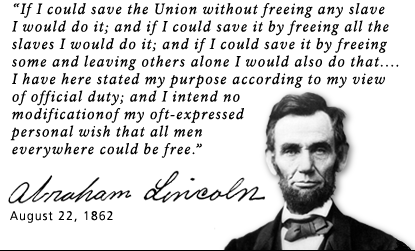
The North wasn’t only against slavery because they were great humanitarians. Many Northerners didn’t like the advantages slavery gave the South. Others in the North incited slave insurrections to cause chaos in the South but did not take care of the slaves once they were freed. Slavery was not the core reason the North wanted war. We can see this fact in Abraham Lincoln’s own words.
The reason for almost all warfare can be boiled down into one specific concept: economic supremacy. The majority of wars today and the majority of wars in the past are fought over economic supremacy. This means that societies most often fight over land, trade routes, money and commodities. The Civil War was no different. Here is Salomon James de Rothschild explaining this fact in great detail:
“The great question over which the representatives of the South and those of the North had been locked in bitter combat for thirty years was the question of tariffs. The South was a producer of raw materials, and a consumer; the North was a manufacturer. Free trade, or at least very moderate custom-duties, was the desire of the inhabitants of the South. The North was contending in favor of protection, often even of the prohibition [of imports]. By the old tariff law, the eastern states and New England furnished the other states merchandise which these latter could procure in Europe at reductions of twenty-five and thirty percent. As soon as the Republican administration (the protector of tariffs) came to power, Congress passed the Morrill Tariff, which raised duties to an unprecedented rate. The states which had seceded responded with a very great decrease in these same tariffs, intimating their eventual, complete abolition when the peaceful state of the country should allow them freedom from recourse to extraordinary measures. The North understood that it was lost if secession continued and made progress. Who would then come to buy the iron products of Pennsylvania and the manufactured goods of New England? It would no longer be by the South, for the South would get its supplies in the European markets and would find a way to pass its purchases into the western states. From that moment on, the South no longer had a supporter in the North; Republicans and Democrats crowded around the flag of the Union. Patriotism and the old memories played some part in this; but believe me, the principal motive was the pocket.”
The North and South were locked in a bitter trade war before the Civil War began. The South wanted free trade while the North wanted protected trade. The North needed to sell its manufactured products to the South to remain economically robust. However, the South knew they could buy the same products from Europe at discounted prices. There is no way the North could let the South secede and expect to maintain their wealth. In simple terms, the Civil War was fought over money.
Slavery caused a rift between the North and South. However, the war was fought because of economic interests going in opposite directions. Neither side was necessarily moral but were merely trying to preserve their way of life.
To read more of Salomon’s writings, which I highly recommend, check out the link here.

No comments:
Post a Comment