The Global Financial Crisis and Great Recession posed daunting new
challenges for central banks around the world and spurred innovations in
the design, implementation, and communication of monetary policy. With
the U.S. economy now nearing the Federal Reserve's statutory goals of
maximum employment and price stability, this conference provides a
timely opportunity to consider how the lessons we learned are likely to
influence the conduct of monetary policy in the future.
The theme
of the conference, "Designing Resilient Monetary Policy Frameworks for
the Future," encompasses many aspects of monetary policy, from the
nitty-gritty details of implementing policy in financial markets to
broader questions about how policy affects the economy. Within the
operational realm, key choices include the selection of policy
instruments, the specific markets in which the central bank
participates, and the size and structure of the central bank's balance
sheet. These topics are of great importance to the Federal Reserve. As
noted in the minutes of last month's Federal Open Market Committee
(FOMC) meeting, we are studying many issues related to policy
implementation, research which ultimately will inform the FOMC's views
on how to most effectively conduct monetary policy in the years ahead. I
expect that the work discussed at this conference will make valuable
contributions to the understanding of many of these important issues.
My
focus today will be the policy tools that are needed to ensure that we
have a resilient monetary policy framework. In particular, I will focus
on whether our existing tools are adequate to respond to future economic
downturns. As I will argue, one lesson from the crisis is that our
pre-crisis toolkit was inadequate to address the range of economic
circumstances that we faced. Looking ahead, we will likely need to
retain many of the monetary policy tools that were developed to promote
recovery from the crisis. In addition, policymakers inside and outside
the Fed may wish at some point to consider additional options to secure a
strong and resilient economy. But before I turn to these longer-run
issues, I would like to offer a few remarks on the near-term outlook for
the U.S. economy and the potential implications for monetary policy.
Current Economic Situation and Outlook
U.S. economic activity continues to expand, led by solid growth in
household spending. But business investment remains soft and subdued
foreign demand and the appreciation of the dollar since mid-2014
continue to restrain exports. While economic growth has not been rapid,
it has been sufficient to generate further improvement in the labor
market. Smoothing through the monthly ups and downs, job gains averaged
190,000 per month over the past three months. Although the unemployment
rate has remained fairly steady this year, near 5 percent, broader
measures of labor utilization have improved. Inflation has continued to
run below the FOMC's objective of 2 percent, reflecting in part the
transitory effects of earlier declines in energy and import prices.
Looking
ahead, the FOMC expects moderate growth in real gross domestic product
(GDP), additional strengthening in the labor market, and inflation
rising to 2 percent over the next few years. Based on this economic
outlook, the FOMC continues to anticipate that gradual increases in the
federal funds rate will be appropriate over time to achieve and sustain
employment and inflation near our statutory objectives. Indeed, in light
of the continued solid performance of the labor market and our outlook
for economic activity and inflation, I believe the case for an increase
in the federal funds rate has strengthened in recent months. Of course,
our decisions always depend on the degree to which incoming data
continues to confirm the Committee's outlook.
And, as
ever, the economic outlook is uncertain, and so monetary policy is not
on a preset course. Our ability to predict how the federal funds rate
will evolve over time is quite limited because monetary policy will need
to respond to whatever disturbances may buffet the economy. In
addition, the level of short-term interest rates consistent with the
dual mandate varies over time in response to shifts in underlying
economic conditions that are often evident only in hindsight. For these
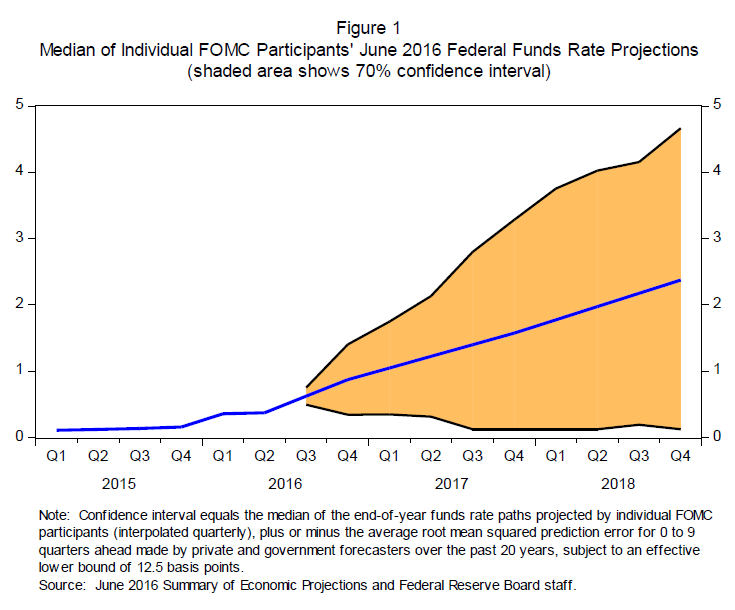
reasons, the range of reasonably likely outcomes for the federal funds
rate is quite wide--a point illustrated by figure 1
in your handout. The line in the center is the median path for the
federal funds rate based on the FOMC's Summary of Economic Projections
in June.1
The shaded region, which is based on the historical accuracy of private
and government forecasters, shows a 70 percent probability that the
federal funds rate will be between 0 and 3-1/4 percent at the end of
next year and between 0 and 4-1/2 percent at the end of 2018.2
The reason for the wide range is that the economy is frequently
buffeted by shocks and thus rarely evolves as predicted. When shocks
occur and the economic outlook changes, monetary policy needs to adjust.
What we do know, however, is that we want a policy toolkit that will
allow us to respond to a wide range of possible conditions.
The Pre-Crisis Toolkit
Prior to the financial crisis, the Federal Reserve's monetary policy
toolkit was simple but effective in the circumstances that then
prevailed. Our main tool consisted of open market operations to manage
the amount of reserve balances available to the banking sector.3
These operations, in turn, influenced the interest rate in the federal
funds market, where banks experiencing reserve shortfalls could borrow
from banks with excess reserves. Before the onset of the crisis, the
volume of reserves was generally small--only about $45 billion or so.4
Thus, even small open market operations could have a significant effect
on the federal funds rate. Changes in the federal funds rate would then
be transmitted to other short-term interest rates, affecting
longer-term interest rates and overall financial conditions and hence
inflation and economic activity. This simple, light-touch system allowed
the Federal Reserve to operate with a relatively small balance
sheet--less than $1 trillion before the crisis--the size of which was
largely determined by the need to supply enough U.S. currency to meet
demand.5
The
global financial crisis revealed two main shortcomings of this simple
toolkit. The first was an inability to control the federal funds rate
once reserves were no longer relatively scarce. Starting in late 2007,
faced with acute financial market distress, the Federal Reserve created
programs to keep credit flowing to households and businesses.6
The loans extended under those programs helped stabilize the financial
system. But the additional reserves created by these programs, if left
unchecked, would have pushed down the federal funds rate, driving it
well below the FOMC's target. To prevent such an outcome, the Federal
Reserve took several steps to offset (or sterilize) the effect of its
liquidity and credit operations on reserves.7
By the fall of 2008, however, the reserve effects of our liquidity and
credit programs threatened to become too large to sterilize via asset
sales and other existing tools. Without sufficient sterilization
capacity, the quantity of reserves increased to a point that the Federal
Reserve had difficulty maintaining effective control over the federal
funds rate.
Of course, by the end of 2008, stabilizing the federal
funds rate at a level materially above zero was not an immediate
concern because the economy clearly needed very low short-term interest
rates. Faced with a steep rise in unemployment and declining inflation,
the FOMC lowered its target for the federal funds rate to near zero, a
reduction of roughly 5 percentage points over the previous year and a
half. Nonetheless, a variety of policy benchmarks would, at least in
hindsight, have called for pushing the federal funds rate well below
zero during the economic downturn.8
That doing so was impossible highlights the second serious limitation
of our pre-crisis policy toolkit: its inability to generate
substantially more accommodation than could be provided by a near-zero
federal funds rate.
Our Expanded Toolkit
To
address the challenges posed by the financial crisis and the subsequent
severe recession and slow recovery, the Federal Reserve significantly
expanded its monetary policy toolkit. In 2006, the Congress had approved
plans to allow the Fed, beginning in 2011, to pay interest on banks'
reserve balances.9
In the fall of 2008, the Congress moved up the effective date of this
authority to October 2008. That authority was essential. Paying interest
on reserve balances enables the Fed to break the strong link between
the quantity of reserves and the level of the federal funds rate and, in
turn, allows the Federal Reserve to control short-term interest rates
when reserves are plentiful. In particular, once economic conditions
warrant a higher level for market interest rates, the Federal Reserve
could raise the interest rate paid on excess reserves--the IOER rate. A
higher IOER rate encourages banks to raise the interest rates they
charge, putting upward pressure on market interest rates regardless of
the level of reserves in the banking sector.
While adjusting the
IOER rate is an effective way to move market interest rates when
reserves are plentiful, federal funds have generally traded below this
rate. This relative softness of the federal funds rate reflects, in
part, the fact that only depository institutions can earn the IOER rate.
To put a more effective floor under short-term interest rates, the
Federal Reserve created supplementary tools to be used as needed. For
instance, the overnight reverse repurchase agreement (ON RRP) facility
is available to a variety of counterparties, including eligible money
market funds, government-sponsored enterprises, broker-dealers, and
depository institutions. Through it, eligible counterparties may invest
funds overnight with the Federal Reserve at a rate determined by the
FOMC. Similar to the payment of IOER, the ON RRP facility discourages
participating institutions from lending at a rate substantially below
that offered by the Fed.10
Our
current toolkit proved effective last December. In an environment of
superabundant reserves, the FOMC raised the effective federal funds
rate--that is, the weighted average rate on federal funds transactions
among participants in that market--by the desired amount, and we have
since maintained the federal funds rate in its target range.
Two other major additions to the Fed's toolkit were large-scale asset purchases and increasingly explicit forward guidance.11
Both were used to provide additional monetary policy accommodation
after short-term interest rates fell close to zero. Our purchases of
Treasury and mortgage-related securities in the open market pushed down
longer-term borrowing rates for millions of American families and
businesses. Extended forward rate guidance--announcing that we intended
to keep short-term interest rates lower for longer than might have
otherwise been expected--also put significant downward pressure on
longer-term borrowing rates, as did guidance regarding the size and
scope of our asset purchases.
In light of the slowness of the
economic recovery, some have questioned the effectiveness of asset
purchases and extended forward rate guidance. But this criticism fails
to consider the unusual headwinds the economy faced after the crisis.
Those headwinds included substantial household and business
deleveraging, unfavorable demand shocks from abroad, a period of
contractionary fiscal policy, and unusually tight credit, especially for
housing. Studies have found that our asset purchases and extended
forward rate guidance put appreciable downward pressure on long-term
interest rates and, as a result, helped spur growth in demand for goods
and services, lower the unemployment rate, and prevent inflation from
falling further below our 2 percent objective.12
Two
of the Fed's most important new tools--our authority to pay interest on
excess reserves and our asset purchases--interacted importantly.
Without IOER authority, the Federal Reserve would have been reluctant to
buy as many assets as it did because of the longer-run implications for
controlling the stance of monetary policy. While we were buying assets
aggressively to help bring the U.S. economy out of a severe recession,
we also had to keep in mind whether and how we would be able to remove
monetary policy accommodation when appropriate. That issue was
particularly relevant because we fund our asset purchases through the
creation of reserves, and those additional reserves would have made it
ever more difficult for the pre-crisis toolkit to raise short-term
interest rates when needed.
The FOMC considered removing
accommodation by first reducing our asset holdings (including through
asset sales) and raising the federal funds rate only after our balance
sheet had contracted substantially. But we decided against this approach
because our ability to predict the effects of changes in the balance
sheet on the economy is less than that associated with changes in the
federal funds rate. Excessive inflationary pressures could arise if
assets were sold too slowly. Conversely, financial markets and the
economy could potentially be destabilized if assets were sold too
aggressively. Indeed, the so-called taper tantrum of 2013 illustrates
the difficulty of predicting financial market reactions to announcements
about the balance sheet. Given the uncertainty and potential costs
associated with large-scale asset sales, the FOMC instead decided to
begin removing monetary policy accommodation primarily by adjusting
short-term interest rates rather than by actively managing its asset
holdings.13
That strategy--raising short-term interest rates once the recovery was
sufficiently advanced while maintaining a relatively large balance sheet
and plentiful bank reserves--depended on our ability to pay interest on
excess reserves.
Where Do We Go from Here?
What does the future hold for the Fed's toolkit? For starters, our
ability to use interest on reserves is likely to play a key role for
years to come. In part, this reflects the outlook for our balance sheet
over the next few years. As the FOMC has noted in its recent statements,
at some point after the process of raising the federal funds rate is
well under way, we will cease or phase out reinvesting repayments of
principal from our securities holdings. Once we stop reinvestment, it
should take several years for our asset holdings--and the bank reserves
used to finance them--to passively decline to a more normal level. But
even after the volume of reserves falls substantially, IOER will still
be important as a contingency tool, because we may need to purchase
assets during future recessions to supplement conventional interest rate
reductions.14 Forecasts now show the federal funds rate settling at about 3 percent in the longer run.15
In contrast, the federal funds rate averaged more than 7 percent
between 1965 and 2000. Thus, we expect to have less scope for interest
rate cuts than we have had historically.
In part, current
expectations for a low future federal funds rate reflect the FOMC's
success in stabilizing inflation at around 2 percent--a rate much lower
than rates that prevailed during the 1970s and 1980s. Another key factor
is the marked decline over the past decade, both here and abroad, in
the long-run neutral real rate of interest--that is, the
inflation-adjusted short-term interest rate consistent with keeping
output at its potential on average over time.16
Several developments could have contributed to this apparent decline,
including slower growth in the working-age populations of many
countries, smaller productivity gains in the advanced economies, a
decreased propensity to spend in the wake of the financial crises around
the world since the late 1990s, and perhaps a paucity of attractive
capital projects worldwide.17
Although these factors may help explain why bond yields have fallen to
such low levels here and abroad, our understanding of the forces driving
long-run trends in interest rates is nevertheless limited, and thus all
predictions in this area are highly uncertain.18
Would
an average federal funds rate of about 3 percent impair the Fed's
ability to fight recessions? Based on the FOMC's behavior in past
recessions, one might think that such a low interest rate could
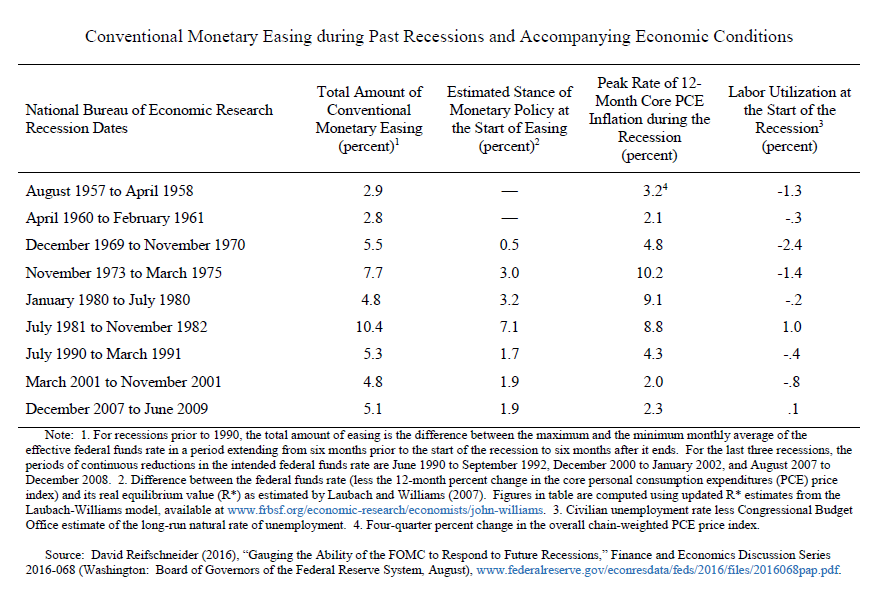
substantially impair policy effectiveness. As shown in the first column
of the table
in the handout, during the past nine recessions, the FOMC cut the
federal funds rate by amounts ranging from about 3 percentage points to
more than 10 percentage points. On average, the FOMC reduced rates by
about 5-1/2 percentage points, which seems to suggest that the FOMC
would face a shortfall of about 2-1/2 percentage points for dealing with
an average-sized recession. But this simple comparison exaggerates the
limitations on policy created by the zero lower bound. As shown in the
second column, the federal funds rate at the start of the past seven
recessions was appreciably above the level consistent with the economy
operating at potential in the longer run. In most cases, this
tighter-than-normal stance of policy before the recession appears to
have reflected some combination of initially higher-than-normal labor
utilization and elevated inflation pressures. As a result, a large
portion of the rate cuts that subsequently occurred during these
recessions represented the undoing of the earlier tight stance of
monetary policy. Of course, this situation could occur again in the
future. But if it did, the federal funds rate at the onset of the
recession would be well above its normal level, and the FOMC would be
able to cut short-term interest rates by substantially more than 3
percentage points.
A recent paper takes a different approach to
assessing the FOMC's ability to respond to future recessions by using
simulations of the FRB/US model.19
This analysis begins by asking how the economy would respond to a set
of highly adverse shocks if policymakers followed a fairly aggressive
policy rule, hypothetically assuming that they can cut the federal funds
rate without limit.20
It then imposes the zero lower bound and asks whether some combination
of forward guidance and asset purchases would be sufficient to generate
economic conditions at least as good as those that occur under the
hypothetical unconstrained policy. In general, the study concludes that,
even if the average level of the federal funds rate in the future is
only 3 percent, these new tools should be sufficient unless the
recession were to be unusually severe and persistent.
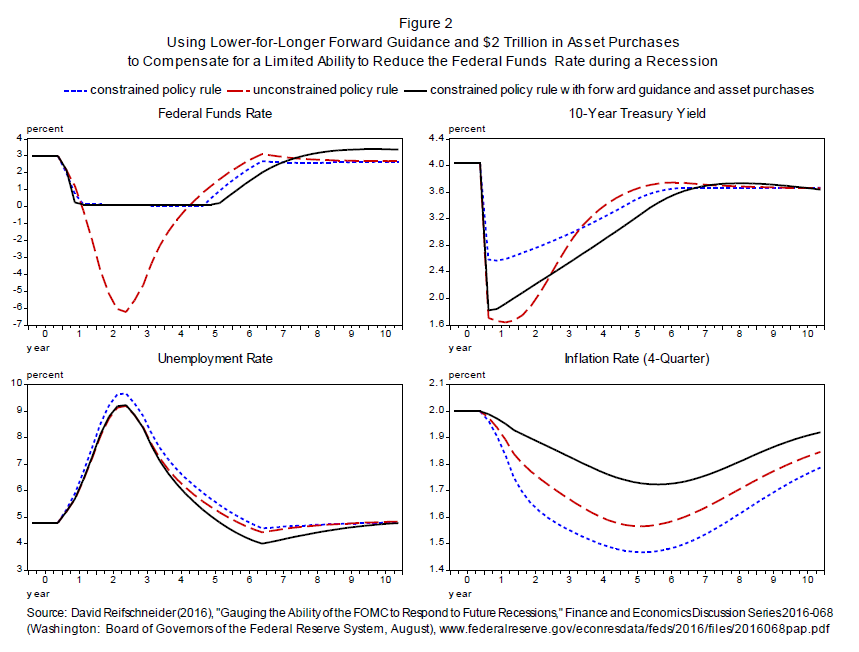
Figure 2
in your handout illustrates this point. It shows simulated paths for
interest rates, the unemployment rate, and inflation under three
different monetary policy responses--the aggressive rule in the absence
of the zero lower bound constraint, the constrained aggressive rule, and
the constrained aggressive rule combined with $2 trillion in asset
purchases and guidance that the federal funds rate will depart from the
rule by staying lower for longer.21
As the blue dashed line shows, the federal funds rate would fall far
below zero if policy were unconstrained, thereby causing long-term
interest rates to fall sharply. But despite the lower bound, asset
purchases and forward guidance can push long-term interest rates even
lower on average than in the unconstrained case (especially when
adjusted for inflation) by reducing term premiums and increasing the
downward pressure on the expected average value of future short-term
interest rates. Thus, the use of such tools could result in even better
outcomes for unemployment and inflation on average.
Of course,
this analysis could be too optimistic. For one, the FRB/US simulations
may overstate the effectiveness of forward guidance and asset purchases,
particularly in an environment where long-term interest rates are also
likely to be unusually low.22
In addition, policymakers could have less ability to cut short-term
interest rates in the future than the simulations assume. By some
calculations, the real neutral rate is currently close to zero, and it
could remain at this low level if we were to continue to see slow
productivity growth and high global saving.23
If so, then the average level of the nominal federal funds rate down
the road might turn out to be only 2 percent, implying that asset
purchases and forward guidance might have to be pushed to extremes to
compensate.24
Moreover, relying too heavily on these nontraditional tools could have
unintended consequences. For example, if future policymakers responded
to a severe recession by announcing their intention to keep the federal
funds rate near zero for a very long time after the economy had
substantially recovered and followed through on that guidance, then they
might inadvertently encourage excessive risk-taking and so undermine
financial stability.
Finally, the simulation analysis certainly overstates the FOMC's current
ability to respond to a recession, given that there is little scope to
cut the federal funds rate at the moment. But that does not mean that
the Federal Reserve would be unable to provide appreciable accommodation
should the ongoing expansion falter in the near term. In addition to
taking the federal funds rate back down to nearly zero, the FOMC could
resume asset purchases and announce its intention to keep the federal
funds rate at this level until conditions had improved
markedly--although with long-term interest rates already quite low, the
net stimulus that would result might be somewhat reduced.
Despite
these caveats, I expect that forward guidance and asset purchases will
remain important components of the Fed's policy toolkit. In addition, it
is critical that the Federal Reserve and other supervisory agencies
continue to do all they can to ensure a strong and resilient financial
system. That said, these tools are not a panacea, and future
policymakers could find that they are not adequate to deal with deep and
prolonged economic downturns. For these reasons, policymakers and
society more broadly may want to explore additional options for helping
to foster a strong economy.
On the monetary policy side, future
policymakers might choose to consider some additional tools that have
been employed by other central banks, though adding them to our toolkit
would require a very careful weighing of costs and benefits and, in some
cases, could require legislation. For example, future policymakers may
wish to explore the possibility of purchasing a broader range of assets.
Beyond that, some observers have suggested raising the FOMC's 2 percent
inflation objective or implementing policy through alternative monetary
policy frameworks, such as price-level or nominal GDP targeting. I
should stress, however, that the FOMC is not actively considering these
additional tools and policy frameworks, although they are important
subjects for research.
Beyond monetary policy, fiscal policy has
traditionally played an important role in dealing with severe economic
downturns. A wide range of possible fiscal policy tools and approaches
could enhance the cyclical stability of the economy.25
For example, steps could be taken to increase the effectiveness of the
automatic stabilizers, and some economists have proposed that greater
fiscal support could be usefully provided to state and local governments
during recessions. As always, it would be important to ensure that any
fiscal policy changes did not compromise long-run fiscal sustainability.
Finally,
and most ambitiously, as a society we should explore ways to raise
productivity growth. Stronger productivity growth would tend to raise
the average level of interest rates and therefore would provide the
Federal Reserve with greater scope to ease monetary policy in the event
of a recession. But more importantly, stronger productivity growth would
enhance Americans' living standards. Though outside the narrow field of
monetary policy, many possibilities in this arena are worth
considering, including improving our educational system and investing
more in worker training; promoting capital investment and research
spending, both private and public; and looking for ways to reduce
regulatory burdens while protecting important economic, financial, and
social goals.
Conclusion
Although fiscal
policies and structural reforms can play an important role in
strengthening the U.S. economy, my primary message today is that I
expect monetary policy will continue to play a vital part in promoting a
stable and healthy economy. New policy tools, which helped the Federal
Reserve respond to the financial crisis and Great Recession, are likely
to remain useful in dealing with future downturns. Additional tools may
be needed and will be the subject of research and debate. But even if
average interest rates remain lower than in the past, I believe that
monetary policy will, under most conditions, be able to respond
effectively.

No comments:
Post a Comment